
What Is a Melamine Board? A Complete Guide
Melamine board is a manufactured wood panel made by bonding melamine resin-coated paper onto a core of particleboard, MDF, or plywood through heat and pressure.
This guide covers what melamine board is made of, how it is manufactured, the main types based on core material, how it compares to plywood, MDF, and other panels, typical price ranges by core and thickness, and how to choose the right board for a specific project. Readers will also learn where melamine outperforms alternatives and what to check before sourcing it.
What Is a Melamine Board?
Melamine board is an engineered wood product made by bonding melamine resin-soaked paper onto a core material under heat and pressure. The core is typically particle board, MDF (medium-density fiberboard), or plywood. This process creates a smooth, durable surface that resists scratches, moisture, and stains.
Common core materials include:
- Particle board – compressed wood particles bonded with adhesive
- MDF – fine wood fibers pressed into a dense, uniform panel
- Plywood – thin wood layers glued together in alternating grain directions
The melamine surface layer fused to these cores is only about 0.2 to 0.4 millimeters thick per face. Despite being thin, it provides significant protection against daily wear.
Advantages:
- Typically costs significantly less than solid wood and often less than finished plywood
- Surface resists water, stains, and everyday wear
- Cleans easily with a damp cloth
- Available in a wide range of solid colors, wood-grain reproductions, and textured finishes
- Arrives pre-finished — no painting or staining required
Disadvantages:
- Chips easily along cut edges
- Cannot be refinished or sanded
- Can scorch or discolor under prolonged contact with very hot items, so it is not intended as a hot-surface worktop
- Shows damage more obviously than wood
- Edges require banding for a finished look
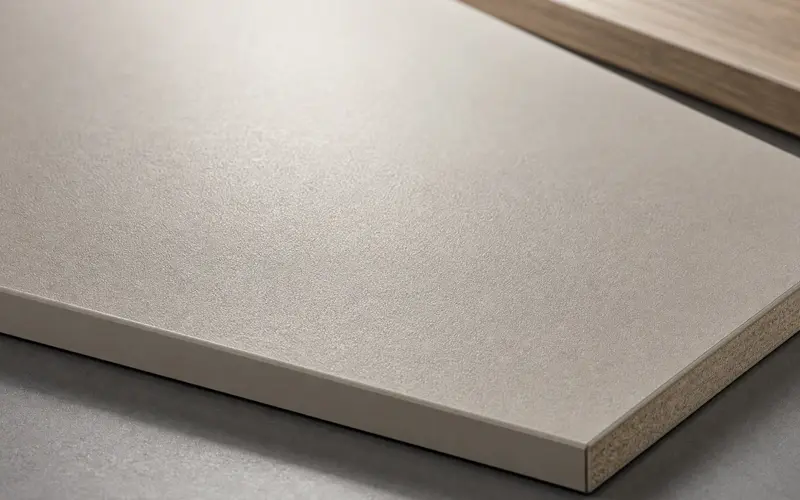
What Is Melamine Board Made Of?
A melamine board has two main components:
Core substrate: Particleboard, MDF, or plywood forms the structural body and determines the panel’s thickness, weight, and screw-holding.
Melamine surface: Decorative paper saturated with melamine-formaldehyde resin is bonded on top to form a hard, pre-finished protective layer about 0.2–0.4 mm thick per face.
How Is Melamine Board Made?
Melamine board is produced as a low-pressure laminate (LPL). Resin-impregnated decorative paper is fused directly onto the prepared core in a single press cycle under heat (about 300–400°F) and roughly 300–500 PSI of pressure. The resin cures during pressing, permanently bonding the paper to the core to form the finished surface. This differs from high-pressure laminate (HPL), which is pressed at over 1,400 PSI as a separate sheet and then bonded to a substrate.
What Are the Different Types of Melamine Board?
Melamine boards are categorized by their core material.
- melamine MDF
- melamine particle board
- melamine plywood
Melamine MDF uses a medium-density fiberboard core. MDF has a smooth, uniform surface that provides consistent quality for furniture and kitchen cabinets. This type works well when a flat surface is needed for painting or decorative finishes.
Melamine particle board is the most common type. It combines wood particles pressed together as the core material with a melamine resin coating on top. This board costs less than MDF options while still providing durability for bathroom cabinets, shelving, and office furniture.
Melamine plywood uses thin wood veneers layered together as the core. This type is stronger than particle board and resists warping better in humid conditions. It works well for heavy-duty shelving and furniture that needs extra structural support or better moisture performance.
How Does Melamine Board Compare to Other Panels?
Melamine board differs from plywood and MDF in three key ways: strength, edge treatment, and cost. Melamine sheets come pre-finished with a hard plastic coating, while plywood and MDF require paint or veneer. This coating on melamine surfaces resists scratches and moisture better than bare MDF but not as well as high-pressure laminates.
Strength and Span Performance
Plywood is stronger than melamine board over long spans. A plywood shelf can hold more weight without sagging than a melamine shelf of the same thickness. Melamine board typically uses MDF or particle board as its core, which makes it heavier than plywood but weaker. MDF without melamine coating weighs the same as melamine board but lacks the protective surface.
Edge Treatment Requirements
Melamine board needs edge banding or edge sealing to protect exposed edges. The melamine coating only covers the flat surfaces, leaving the core material visible and vulnerable at the edges. Plywood edges show layers of wood veneer. MDF edges are smooth but absorb moisture unless sealed or painted.
Cost
Melamine board generally costs less than finished plywood and far less than solid wood, because it arrives pre-finished on an economical core. Raw MDF is cheaper than melamine board but must be painted or veneered before use. Plywood with a hardwood veneer costs more but offers superior strength for structural cabinet construction.
What Is Melamine Board Used For?
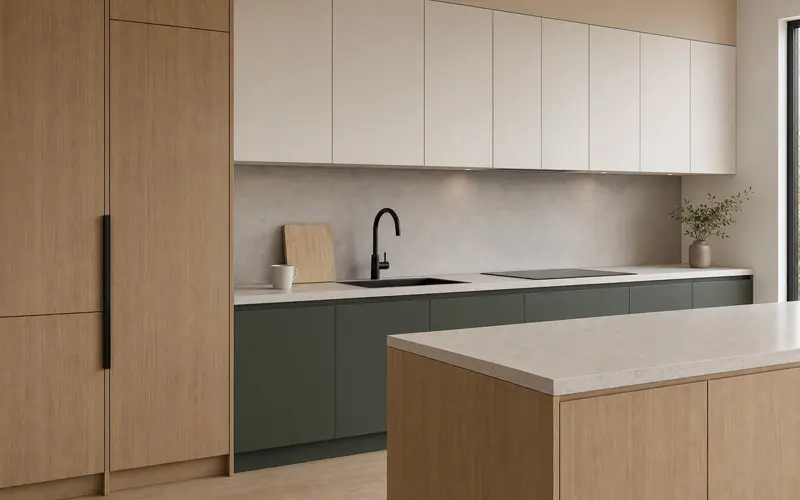
Melamine boards show up in cabinet boxes, shelving systems, office furniture, and commercial fixtures. The pre-finished surface and low cost make it practical for interior applications where appearance matters but structural loads stay moderate.
Kitchen and bathroom cabinets use melamine board for interior boxes and shelving. The moisture-resistant melamine surfaces wipe clean and hold up in humid spaces. Cabinet makers apply edge banding to cover the raw substrate along cut edges.
Closet and pantry shelving relies on melamine sheets for quick installation. No painting or sealing is required. The material goes up fast in spaces where a clean, finished look matters.
Office furniture including desks, bookcases, and storage units uses melamine board regularly. The smooth melamine surfaces resist daily wear and cost less than solid wood or finished plywood.
Retail display cases and commercial fixtures use melamine board for durability. The material handles daily traffic and requires minimal upkeep. Multiple color and texture options let designers match specific aesthetic requirements.
Whiteboards in classrooms and offices use white melamine board. The surface accepts dry-erase markers and erases cleanly.
How Much Does Melamine Board Cost?
Melamine board is one of the most cost-effective pre-finished panels, typically cheaper than finished plywood and far less expensive than solid wood. The exact price depends on the core type, thickness, surface finish, emission grade, and order volume, so figures vary by market and over time.
The core substrate drives most of the cost. Particleboard cores are the most economical, MDF cores are moderately higher because they use refined wood fibers, and plywood cores are the most expensive because they add structural strength.
Thickness affects price directly: a 6 mm back panel uses far less material than an 18 mm carcass panel. Standard furniture panels are 16–18 mm thick.
Other factors that raise the price:
Order volume: small orders carry a significant per-unit premium, while larger bulk orders achieve the best unit pricing.
Emission grade: ultra-low-formaldehyde boards (E0 / ENF) cost more than standard E1 panels, but increasingly match the indoor requirements of major markets such as CARB Phase 2 and TSCA Title VI.
Surface finish: synchronized wood-grain textures and high-gloss finishes cost more than standard solid colors.
Edge banding is priced separately and adds to the total project cost, since cut edges expose the core and need sealing.
For accurate, current pricing on a specific specification and volume, request a quote rather than relying on published ranges.
How Do You Choose the Right Melamine Board for Your Project?
The right melamine board depends on where you’ll use it and what performance you need. Start by identifying whether the project requires durability, moisture resistance, or specific aesthetics.
Check the substrate quality before buying. High-quality particleboard should have density at or above 650 kg/m³. Medium-density fiberboard (MDF) offers better surface smoothness at 720 kg/m³ or higher.
Inspect melamine sheets for surface defects. The board should have no bubbles, scratches, or uneven areas. Color and texture must remain consistent across the entire sheet.
Edge banding matters for finished appearance and protection. Exposed edges absorb moisture and reduce board lifespan. Quality edge sealing prevents delamination and water infiltration.
Verify formaldehyde emissions meet the standard required in your market. E1 (≤1.5 mg/L) is the common baseline for indoor panels and broadly aligns with CARB Phase 2 and TSCA Title VI, while E0 (≤0.5 mg/L) and ENF offer the lowest emissions for sensitive applications.
Compare thickness options based on load requirements:
| Thickness | Best Use |
| 12-15mm | Shelving, wall panels |
| 16-18mm | Cabinet boxes, furniture |
| 25mm+ | Heavy-duty shelving, work surfaces |
Test nail-holding capacity on sample boards if possible. Dense, uniform substrate prevents screws from loosening over time.
FAQs
Is Melamine Board the Same as MDF?
No; MDF is a possible core, while melamine board is that core with a melamine surface already bonded at the factory.
Can Melamine Board Be Used Outdoors?
No; it is an interior product. Moisture and UV degrade the core and surface, so it is unsuitable for exterior use.
Can Melamine Board Be Painted?
Yes, but only after scuff-sanding and a bonding primer; most buyers choose melamine to skip painting entirely.
Can Melamine Board Hold Screws?
Yes, though screw-holding is weaker than plywood; use coarse-thread screws, pilot holes, and avoid the edges.
How Long Does Melamine Board Last?
Indoors with proper edge sealing, melamine furniture commonly lasts 10+ years before surface or core wear becomes an issue.
Learn More About Our Products?
Contact Now