
What Is Wood Veneer? Types, Cuts, and Modern Applications
Wood veneer is a thin slice of real wood—typically 0.5mm to 3mm thick—cut from a log and bonded to a substrate like plywood, MDF, or particleboard to create the look of solid timber at a lower cost. It preserves the natural grain, color, and figure of species such as walnut, oak, and maple.
Drawing on SUMEC’s many years of manufacturing and exporting wood-based panels since 1978—backed by FSC, CARB, and CE certifications across 100+ countries—this guide explains everything you need to know. You’ll learn how veneer is made, the main cutting methods and types, how veneer compares to laminate and solid wood, its key benefits and applications, plus answers to the most common questions.
What Is Wood Veneer?
Wood veneer is thin slices of real wood cut from logs and glued onto flat surfaces like doors, cabinets, and furniture. The slices measure between 0.5mm and 3mm thick. Each slice retains the natural grain patterns and unique markings from the original tree.
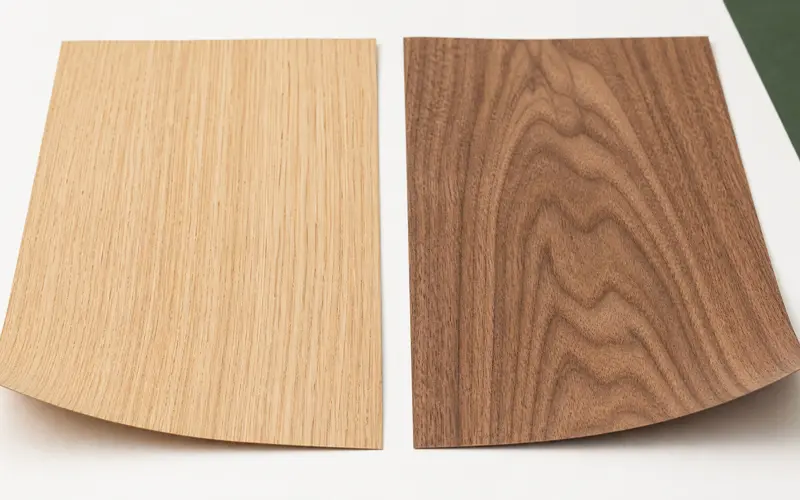
The visible surface shows the tree’s growth rings and natural characteristics. Quarter-cut veneers display a straight grain pattern, while plain-sliced cuts reveal cathedral patterns. These variations come from how the log is cut during manufacturing.
Benefits of wood veneer include:
- dimensional stability
- environmental efficiency
- aesthetic flexibility
Veneer sheets resist warping better than solid wood because they respond less to humidity changes. They also generate less waste during production compared to solid lumber.
How Is Wood Veneer Made?
Wood veneer is made by slicing thin layers of wood from logs using specialized cutting machines. The process preserves the natural grain patterns while creating sheets that typically measure 0.5mm to 3mm thick.
Several cutting methods produce different veneer types:
- A rotary lathe spins the log against a blade, peeling off continuous sheets used mainly for plywood.
- A slicer moves a flitch up and down against a blade to produce plain-sliced (crown-cut) veneer with a cathedral grain.
- Quarter slicing cuts the flitch at roughly 90° to the growth rings for straight, uniform grain.
- Rift slicing cuts at a slight angle (about 15°) to the radius to minimize ray fleck, mostly on oak.
- A half-round (stay-log) lathe mounts a flitch off-center to produce half-round veneer—a look between rotary and plain-sliced.
Natural veneer comes directly from this cutting process and includes several forms:
- Raw veneer has no backing and can be used with either side facing up
- Paper-backed veneer joins smaller pieces together with paper backing for easier handling on curves
- Phenolic-backed veneer uses synthetic backing for stability in composite applications
- Laid up veneer consists of raw veneer pieces joined together to create larger sheets
What Are the Main Types of Wood Veneer?
Wood veneer falls into two main construction types: natural veneer and reconstituted veneer. Natural veneer consists of thin slices cut directly from real wood logs. Reconstituted veneer (also called engineered veneer) is made from real wood—usually fast-growing species—that is sliced, dyed, glued into a block, and re-sliced into uniform sheets that mimic exotic species.
Natural veneer can be paper-backed or unbacked. Paper-backed veneer has a thin paper layer glued to the back for stability during installation. Unbacked veneer offers more flexibility for craftspeople who prefer traditional application methods.
The cut type determines the grain pattern and appearance of veneer wood:
Rotary Cut Veneer – The log spins on a lathe while a blade peels off continuous sheets. This produces the widest veneer panels at the lowest cost. The grain shows bold, sweeping patterns with a dramatic cathedral look.
Plain Sliced Veneer – The log is sliced lengthwise parallel to its center. This creates the classic cathedral grain pattern that repeats across each sheet. Most furniture and cabinetry use this cut.
Quarter Sliced Veneer – The blade cuts perpendicular to the growth rings at a 90-degree angle. This produces straight grain with tight, parallel lines. Oak species show distinctive ray fleck patterns with this method.
Rift Cut Veneer – The log is cut at a slight angle to minimize ray fleck and growth ring visibility. This creates refined, straight grain without the stark uniformity of quarter slicing. Oak and similar species benefit most from rift cutting.
Shop-Sawn Veneer – Individual craftspeople slice veneer from boards using specialized saws. These sheets range from 1mm to 3mm thick and allow custom grain matching for small projects.
Veneer vs Laminate vs Solid Wood — What’s the Difference?
Veneer is a thin layer of real wood (typically up to 3 mm) glued onto a core such as MDF or plywood. Laminate is a printed wood-grain image fused onto fiberboard. Solid wood is lumber used throughout the entire piece.
The three differ on four points:
- Construction: veneer = sliced real wood bonded to a substrate; laminate = melamine-soaked printed paper fused to a fiberboard core under heat; solid wood = thick lumber boards throughout.
- Appearance: veneer and solid wood show authentic, varying grain from real trees; laminate prints a repeating pattern with no natural variation.
- Durability: laminate best resists scratches and moisture with minimal care; veneer can be lightly refinished once but may bubble if it gets wet; solid wood refinishes most often but warps with humidity.
- Cost: laminate is cheapest, veneer sits mid-range (real-wood look at 40–60% less than solid), solid wood is most expensive.
What Are The Benefits of Wood Veneer?
What Are the Benefits of Wood Veneer?
Wood veneer delivers the authentic look of natural wood with advantages that solid lumber can’t match—lower cost, better stability, lighter weight, and greater design flexibility.
Its key benefits include:
- Lower cost than solid wood: Veneer provides the same natural appearance for less. A walnut veneer sheet gives you authentic walnut grain at a fraction of the price of solid walnut lumber.
- Better stability: Solid wood expands and contracts with humidity, leading to warps and cracks. Veneer bonded to a plywood base resists this movement because the engineered core controls the wood’s natural tendency to shift.
- Resource efficiency: One log yields far more veneer sheets than solid boards, stretching natural resources further and reducing waste—making veneer an environmentally responsible choice.
- A species for every design: Different veneers suit different needs—walnut veneer for dark, rich premium furniture; maple veneer for light, clean modern spaces; oak veneer for traditional classic patterns; and softwood veneer as a budget-friendly option for painted finishes.
- Lighter weight: Veneer sheets weigh less than solid wood, easing installation and reducing structural load. A veneered cabinet door weighs roughly 60% less than its solid wood equivalent.
- Adapts to curves and complex shapes: The thin material bends without breaking, so it wraps around curved surfaces and flowing forms that solid wood cannot achieve.
- Minimal maintenance: Most veneer surfaces need only regular dusting and occasional polishing. With proper sealants applied, water resistance improves enough to suit kitchens and bathrooms.
What Is Wood Veneer Used For?
Wood veneer serves as a decorative surface material for furniture, cabinets, doors, and wall panels. Manufacturers glue thin veneer sheets onto cheaper core materials like plywood, particle board, or medium-density fiberboard to create finished products that look like solid wood at lower cost.
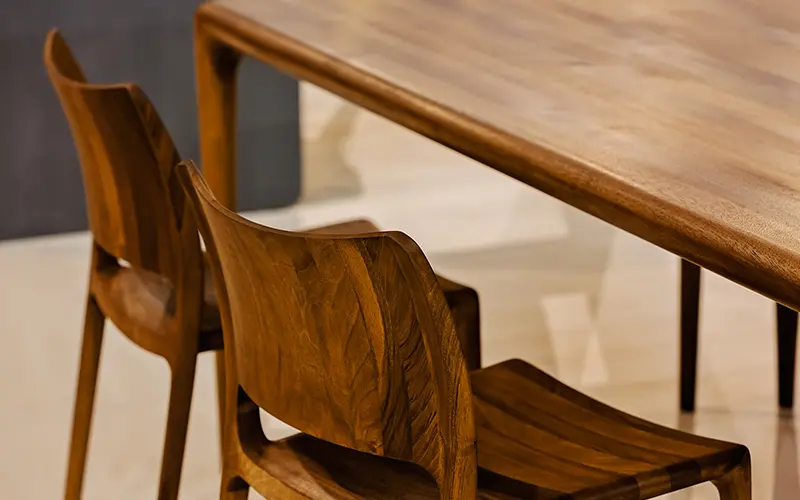
Furniture makers use veneer species like walnut veneer, maple veneer, and oak to produce tables, chairs, desks, and bed frames. The thin wood layers allow them to match grain patterns across large surfaces while using less rare or expensive wood. Cabinet doors and drawer fronts feature veneer panels that provide consistent color and grain throughout a kitchen or bathroom.
Common applications include:
- Cabinet and furniture surfaces
- Architectural wall panels and columns
- Interior doors and door skins
- Musical instruments (pianos, guitars)
- Decorative trim and molding
- Flooring (parquet patterns)
FAQs
Is wood veneer real wood?
Wood veneer is real wood—thin slices cut directly from actual logs, not synthetic or printed material. Each sheet shows authentic grain, color, and character from its species, and it stains, ages, and develops patina just like solid lumber. Only the thickness differs.
How thick is wood veneer?
Most wood veneer is 0.5mm to 3mm thick (about 0.02–0.12 inch). Thin paper-backed and commercial veneers run 0.5–0.7mm and flex for curves, while thicker shop-sawn veneers reach up to 3mm, allowing more sanding but less flexibility.
Is wood veneer waterproof?
Wood veneer is not waterproof without sealing—raw veneer absorbs moisture and can swell, warp, or delaminate. Polyurethane, lacquer, or marine-grade finishes create a protective barrier, and phenolic-backed veneer resists water better than paper-backed, though the exposed surface still needs sealing.
Is veneer cheaper than solid hardwood?
Veneer costs about 40–60% less than solid hardwood of the same species, since one veneer-grade log yields 30–40 times more decorative surface than sawn boards. Exotic species save even more, and veneer panels also install faster than solid wood.
Learn More About Our Products?
Contact Now