
High Strength Raw MDF: High-Performance Unfinished Medium-Density FiberboardProduct Overview: Basic Properties of High-Strength Substrate
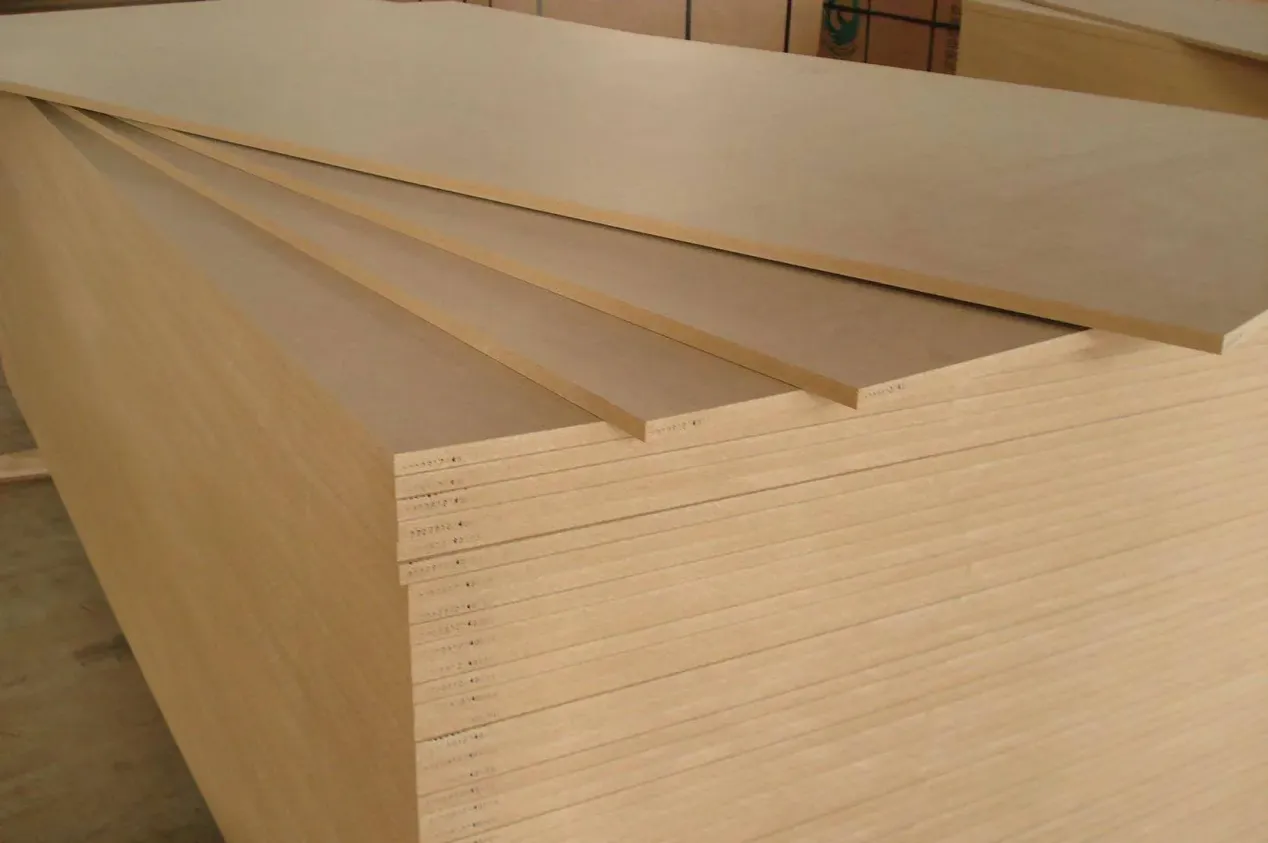
High Strength Raw MDF (High-Strength Unfinished Medium-Density Fiberboard) is an engineered wood product made from high-quality wood fibers as the main raw material, mixed with environmentally friendly resin adhesives, and pressed under high temperature and pressure. Different from ordinary MDF, its density usually maintains a range of 750–850 kg/m³, with a uniform and dense internal structure, free of knots, voids and texture differences, providing a stable foundation for subsequent processing and application. As an unfinished board, it retains the original characteristics of the board, is suitable for various secondary processing technologies, and is one of the commonly used substrates in the field of furniture manufacturing and interior decoration.
Process Features: Refined Production Ensures Basic Performance
The production process of High Strength Raw MDF relies on a mature process system, with attention to detail control from raw material selection to finished product forming. The raw materials mostly use high-quality softwood such as poplar and some hardwood mixed fibers, which are crushed and ground to form fine and uniform fiber pulp. After the fibers are fully mixed with environmentally friendly glue, through processes such as paving, pre-pressing and hot pressing, the fibers and adhesives are closely combined under high temperature and pressure to improve the density uniformity of the board. After subsequent sanding and cutting, the surface is flat and smooth, and the thickness tolerance is controlled within a small range, providing good adaptability for processing links such as carving, molding and facing.
Core Characteristics: Balanced Performance of Strength and Stability
Compared with conventional MDF, High Strength Raw MDF has closely combined internal fibers, better flexural strength and modulus of elasticity, and good load-bearing capacity. Its surface and internal density are consistent, without obvious loose areas, and it has strong screw holding force, reducing the possibility of loosening and slipping during use, making it suitable for various components that require a certain load-bearing capacity. As an unfinished board, its original surface is fine and smooth, without texture defects of natural wood. When applying paint, pasting melamine, covering PVC and other facing materials, the adhesion is uniform, and it is not easy to have problems such as bottom exposure and blistering. At the same time, it has strong plasticity and can be processed into carvings, arcs, moldings and other shapes to meet diverse design needs. Under normal indoor temperature and humidity conditions, the board has a small range of thermal expansion and contraction, and is not easy to have obvious deformation and warpage. Its uniform internal structure makes it relatively balanced by environmental influences, and its dimensional stability is easier to control compared with some natural woods. The product is produced with environmentally friendly glue, and its formaldehyde emission meets relevant standards and international certification requirements. It has little impact on indoor air quality under normal use, is suitable for most indoor environments such as residences and office spaces, and has good compatibility with other furniture materials.
Common Application Scenarios: Suitable for Various Indoor Uses
Based on its own strength and processing characteristics, High Strength Raw MDF is mostly used in indoor scenarios that require a certain degree of substrate stability and processability. In the furniture field, it can be used for wardrobe cabinets, cabinet side panels, desk tops, bookshelf laminates, etc., and is suitable for custom furniture components such as molded door panels and blister door panels. In the decoration field, it can be used as indoor wall panels, background wall substrates, door and window casing lines, decorative carving substrates, etc., to meet the decoration needs of simple or complex shapes. In addition, it can also be used in engineering scenarios such as commercial display cabinets and hotel fixed furniture, suitable for dry and ventilated indoor environments.
Usage Notes: Rational Use to Extend Service Life
Although the product has good stability, it still has a certain degree of hygroscopicity. If it is in a humid environment for a long time or in direct contact with water, it may absorb water and expand, mold and other phenomena. It is necessary to keep the environment dry and ventilated during storage and use, and timely edge-seal the end face of the board after cutting to reduce water infiltration. Although its strength is better than that of ordinary MDF, it belongs to the category of medium-density fiberboard and is not suitable for heavy-duty structural load-bearing or long-term high-load scenarios. During design and use, it is necessary to combine the thickness and strength parameters of the board, reasonably plan the load-bearing span and load, and avoid deformation caused by excessive pressure. When performing cutting, drilling and other processing, it is recommended to use sharp tools to reduce edge chipping and slagging of the board. When screwing on the edge, pre-drilling can be done to reduce the risk of board cracking. When performing carving and molding processing, control the cutting depth and speed to ensure processing accuracy. At the same time, it should not be exposed to high temperature and sun exposure for a long time to prevent board aging, discoloration and performance degradation, and avoid being used in outdoor, kitchen, bathroom and other humid areas or areas directly exposed to water vapor. If it needs to be used in areas with high humidity, it can be matched with moisture-proof facing or special protective treatment.