
What Is Melamine Board? A Guide to Uses, EN Standards & Safety
Melamine board is a staple in the building industry. It is cost-effective, durable, and delivers consistent professional aesthetics. It is widely specified in commercial kitchens, offices, and retail fit outs. It is industrially referred to as a wood-based composite panel. However, the technology is much more advanced.
This material is an engineered solution. It solves many problems for furniture makers. It supports cost efficiency for commercial projects. It meets strict global standards. In this guide, we break down the facts. We use data from industry leaders. We explain why this board is widely adopted in modern furniture and interior construction, with the global market valued at over $18.6 billion in 2025.
What Is the Technical Structure of This Material?
Melamine board is a high-tech “sandwich.” It is formally called Thermally Fused Melamine (TFM). It consists of three distinct parts. These parts work together to create a solid panel.
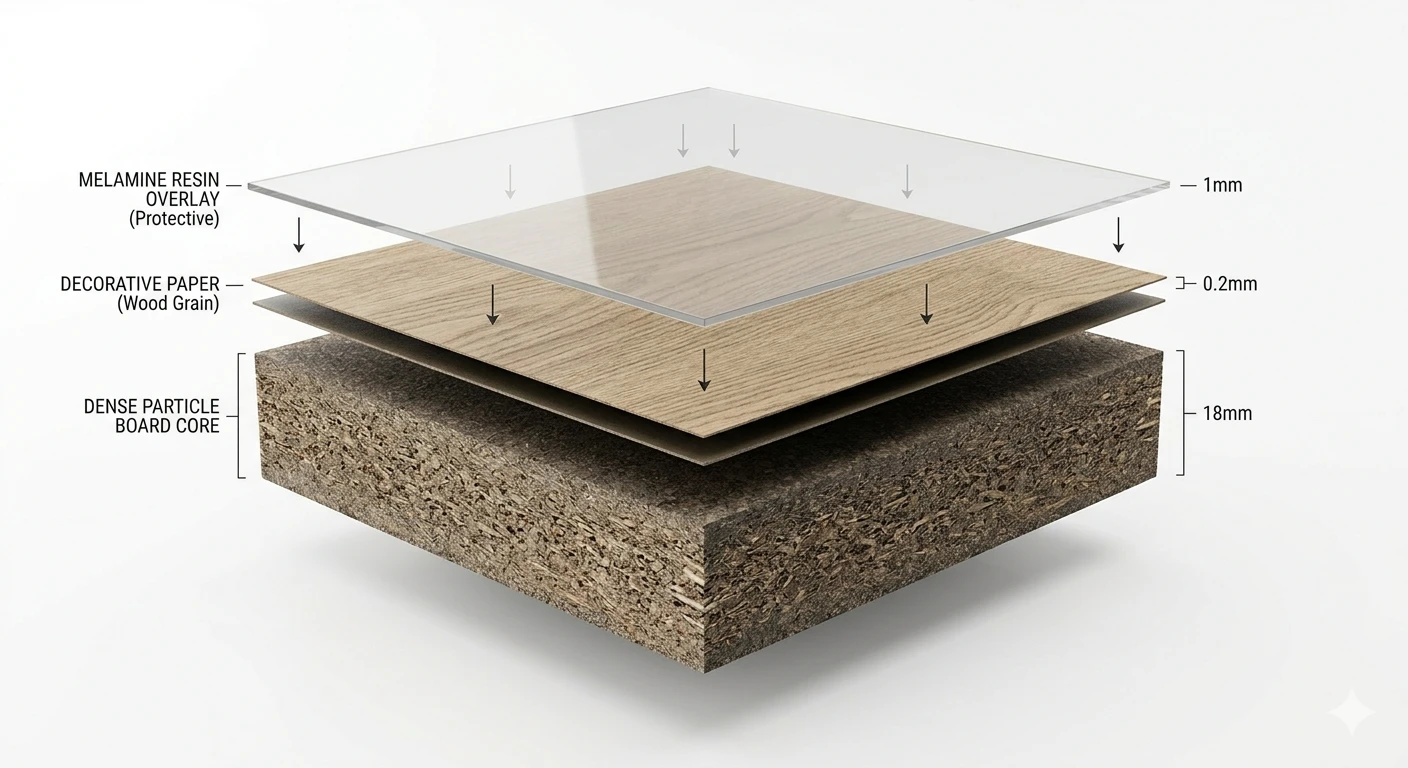
Source: Concept illustration Generated By AI
- The Internal Core: This is the base of the board. Most factories use Particle Board. Some high-end projects use MDF (Medium Density Fiberboard). This core provides the weight. It also provides the structural shape.
- The Decorative Paper: This layer carries the aesthetics. It is a specialized paper. It can mimic wood, stone, or solid colors. It gives the board its final look.
- The Melamine Resin: This is the protective shield. The paper is soaked in this hard plastic resin. It becomes a transparent, tough skin.
Factories use heat to bond these layers. They also use high pressure. The resin melts into the wood fibers. It creates a permanent bond. The surface will not peel off. It will not bubble over time.
Why Does Melamine Resist Damage So Well?
Durability is a mechanical necessity. Builders choose melamine for its physical properties. Melamine panel performance complies with EN 14322, the European standard for melamine faced wood based panels.
- It resists scratches: The resin surface is very hard. Keys and tools do not leave marks easily.
- It handles heat: It exhibits good heat stability for daily contact applications. The board will not melt or change color.
- It fights stains: The surface has no open pores. Its non-porous surface allows easy cleaning of common industrial and commercial contaminants.
In professional labs, machines rub the surface 1,000 times. High-quality boards pass this test easily. They stay bright and smooth for years. This performance aligns with the technical guidelines published by the Composite Panel Association (CPA).
Does Melamine Meet Global Safety Standards?
Safety is the top priority in construction. Modern boards must be “green.” We look at globally accepted certifications for guidance.
- Low Chemical Emissions: Quality boards must follow EPA TSCA Title VI and CARB Phase 2 limits. This rule limits formaldehyde gas. It keeps the indoor air clean.
- The E0 Safety Grade: This is the highest environmental rating. E0 boards have almost zero emissions. They are safe for hospitals. They are safe for nurseries.
- Sustainable Sourcing: FSC and PEFC standards require the use of recycled wood. Factories use wood chips from other mills. We do not cut down extra trees. This protects our natural forests.
You get a safe product. This supports responsible forestry and circular economy goals. This is the goal of sustainable building.
How Does Melamine Compare to Other Materials?
Choosing the right material is a logical step. You must compare the facts. Melamine often wins on price and maintenance.
| Feature | Melamine Board | Solid Wood | Plywood |
| B2B Cost | Very Low | Very High | Moderate |
| Stability | Excellent (No Warp) | Poor (Can Twist) | Good |
| Surface Finish | Factory Sealed | Needs Sanding | Needs Paint |
| Durability | High Scratch Resistance | Low/Medium | Medium |
Where Should You Use This Material?
In real-world projects, melamine is a “workhorse.” It fits into many different scenarios.
1. The Modern Kitchen Cabinet
Melamine cabinets are the industry standard. They stay beautiful in humid conditions.
2. The High-Traffic Office Desk
Offices need many desks. Melamine provides a flat writing surface. It handles the weight of heavy monitors. It maintains long-term color stability under continuous ambient lighting.
3. The Retail Wall System
Stores want a clean look. White melamine reflects light perfectly. It makes the products look better. Modular design enables cost-efficient component replacement.
4. The Professional Closet
Closets need many adjustable shelves. Melamine is easy to cut and drill. It does not have splinters. It supports reliable long-term performance.
How Do You Choose the Right Thickness?
Thickness is a force calculation. You must match the board to the weight it carries.
- 12mm (0.5 inch): Suitable for light-duty applications. Use it for drawer bottoms. Use it for wall panels.
- 18mm (0.75 inch): This is the industry standard thickness. Use it for cabinet sides. Use it for standard bookshelves. It offers the best balance of strength and cost.
- 25mm (1.0 inch): This is for heavy loads. Use it for long workbenches. Use it for library shelving. It minimizes long-term deflection.
Industry Advice: If your shelf is longer than 80cm, add a support. Even thick boards can bend under pressure.
What Are the Best Professional Tips for Workers?
Professional processing requires correct tooling and methods. It is different from working with soft pine wood.
- Use High-Tooth Blades: Melamine is brittle on the edges. Use a saw blade with 80 teeth or more. This creates a clean, sharp cut. It prevents “chipping.”
- Always Apply Edge Banding: The core hates water. You must seal the raw edges. Use PVC Edge Banding. It provides reliable moisture protection for the core material.
- Use Proper Fasteners: Do not use standard nails. Use “Confirmat” screws or cams. These grip the particle core tightly. They create a strong, lasting joint.
Why Is Melamine a Sustainable Hero?
Melamine board offers strong environmental and sustainable benefits. It represents efficiency in manufacturing.
- Waste Reduction: It uses wood fibers that others throw away. We turn factory waste into high-value furniture.
- Long Life: It does not rot. It does not need frequent replacement. This reduces the amount of furniture in landfills.
- Forest Efficiency: One tree produces more melamine sheets than solid planks. We get more value from every forest.
Conclusion
Melamine board is a smart choice. It is not a low-cost substitute. It is a high-performance material. It delivers cost efficiency and ensures indoor air safety.
For office fit-outs, commercial kitchen projects, and large-scale furniture manufacturing, consider melamine. It offers a perfect balance of strength and style. It is a reliable partner for any professional builder.
FAQ: Quick Answers for Buyers
Q: Is melamine board waterproof?
A: The surface is waterproof. The resin protects it. However, the edges are not. You must use edge banding to keep water out of the core.
Q: Does it have a strong smell?
A: Low-quality boards might. Always ask for E0 or E1 grade products for a healthy home.
Q: Can I paint my melamine cabinets?
A: It is difficult. The surface is too smooth. Paint does not stick well. It is better to choose the right color before you buy.
Q: Is it harder than plywood?
A: The surface is much harder. It resists scratches better. However, plywood is often stronger for structural loads like flooring.
Learn More About Our Products?
Contact Now