
What Is HDF (High Density Fiberboard)? Properties, Uses, and Buying Guide
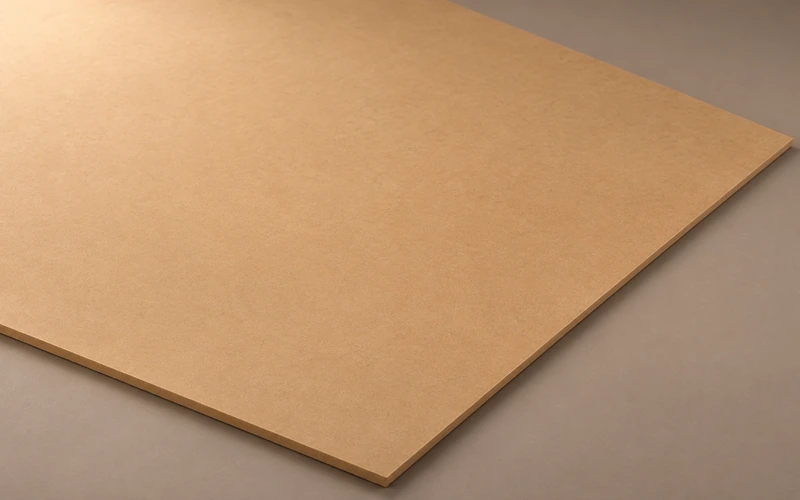
HDF, or high density fiberboard, is a wood panel made from refined wood fibers that are glued and pressed under high heat and pressure. Its density is normally above 800 kg/m³, which makes it harder, smoother, and more stable than MDF. HDF is used most often for door skins, laminate flooring cores, and furniture parts.
This guide was prepared by the technical team at SUMEC Building Material, a China-based manufacturer and exporter that supplies plywood, fiberboard, and particle board to buyers in more than 100 countries. It covers what HDF is made of, how it is produced, its key specifications, how it differs from MDF, and how buyers can check quality before they place an order.
What Is HDF (High Density Fiberboard)?
HDF is a dry-process fiberboard with a density above 800 kg/m³. Door skin grades often reach 850 to 1,000 kg/m³. The key point is simple: density defines HDF, not thickness. A 3 mm board and a 12 mm board can both be HDF if the density is high enough.
Fiberboard is grouped by density into three families, e.g., LDF (under 650 kg/m³), MDF (650 to 800 kg/m³), and HDF (above 800 kg/m³). All three start from the same raw fiber, and the press settings create the difference. HDF also goes by other names, e.g., hardboard, super MDF, and high density MDF. Buyers should judge a board by its technical data sheet, not its trade name.
HDF gives factory buyers several clear benefits, e.g., door plants, flooring mills, and cabinet makers:
- A hard, smooth face that takes paint, primer, or melamine film with little preparation.
- Sharp moulded detail, because high density holds fine grain patterns without soft edges.
- Good dimensional stability indoors, so large door skins stay flat.
- Tight thickness tolerance, usually ±0.2 mm, which suits automatic door lines.
- Efficient raw material use, since HDF is made from chips and mill residues.
HDF also has real limits, and honest suppliers state them:
- It is heavy, so freight cost per container rises.
- It is not waterproof and swells if the edges stay open.
- Edge screw holding is weak, and thin edges can split.
- It is not structural and must not carry load in framing.
- It wears tools faster than plywood and can crack in tight curves.
In short, HDF is the wrong choice for outdoor work, wet rooms, and load-bearing frames. It is the right choice when a project needs a flat, hard, paintable surface indoors.
What Is HDF Made Of? The HDF Manufacturing Process
HDF is made of wood fiber, resin, wax, and a small share of additives. Wood fiber makes up roughly 80 to 90 percent of the panel by weight. Mills use several resin types, e.g., UF, MUF, and pMDI. The resin choice sets both the moisture behavior and the emission grade of the finished board.
The dry process runs in six main steps:
- Chipping. Logs and mill residues are cut into small, even chips.
- Refining. Steam softens the chips, and a refiner separates them into single fibers.
- Drying and blending. Fibers are dried, then resin and wax are sprayed on.
- Forming. The fibers are laid into an even mat on a moving belt.
- Hot pressing. Heat and pressure compress the mat and set the density.
- Sanding and cutting. The cooled board is sanded and trimmed to size.
An older wet process uses water instead of resin and relies on natural lignin to bond the fibers, which makes traditional hardboard. Most HDF traded today comes from the dry process, because it gives better thickness control.
Key Properties and Specifications of HDF Board
The table below lists the specifications buyers normally check on a quotation. Actual figures change from mill to mill, so the supplier’s technical data sheet always comes first.
| Property | Typical range for HDF |
| Density | 800 – 1,050 kg/m³ |
| Common thickness | 2.5 – 8 mm |
| Standard panel size | 1,220 × 2,440 mm |
| Modulus of rupture (MOR) | 35 MPa and above |
| Internal bond strength | 0.60 MPa and above |
| Thickness swelling, 24 h soak | about 8 – 12% |
| Formaldehyde grade | E1, E0, ENF, or CARB P2 / TSCA Title VI |
| Surface finish | Sanded, primed, or melamine faced |
Density predicts surface hardness and moulding detail. MOR shows how much bending the board takes before it breaks. Internal bond shows how well the core holds together, which matters when a door skin is glued to a frame.
HDF moisture resistance and its limits
HDF is not waterproof. A good HDF board swells about 8 to 12 percent in thickness after a 24-hour soak, while standard MDF often swells 15 to 20 percent in the same test. Moisture-resistant HDF uses MUF or pMDI resin plus extra wax to lower that figure. Even so, sealing matters more than the grade. Cut edges absorb water far faster than the sanded face, so every edge and drill hole needs paint or edge banding.
HDF vs MDF: Key Differences Explained
HDF and MDF differ mainly in density, and that one difference drives everything else. The comparison below shows where each board performs better.
| Point of comparison | HDF | MDF |
| Density | Above 800 kg/m³ | 650 – 800 kg/m³ |
| Usual thickness | 2.5 – 8 mm | 9 – 30 mm |
| Surface hardness | Higher; resists dents | Lower; dents more easily |
| Thickness swelling | About 8 – 12% | About 15 – 20% |
| Fine moulded detail | Very good | Fair |
| Weight per panel | Heavier | Lighter |
| Cost per m³ | Higher | Lower |
| Typical use | Door skins, flooring cores | Cabinet doors, shelves |
One common mistake is worth clearing up: HDF is not simply thicker MDF. In practice it is usually the thinner board. A factory picks HDF for surface hardness and fine detail in a thin sheet, and MDF for body and thickness at a lower cost. SUMEC supplies both, and its MDF product range sits alongside HDF for buyers who need both in one shipment.
What Is HDF Used For? Common Applications of HDF
HDF is used wherever a project needs a thin panel with a hard, flat face. Three applications account for most of the global trade volume, and each one relies on a different property, so the grades are not interchangeable.
HDF Door Skins for Moulded and Flush Doors
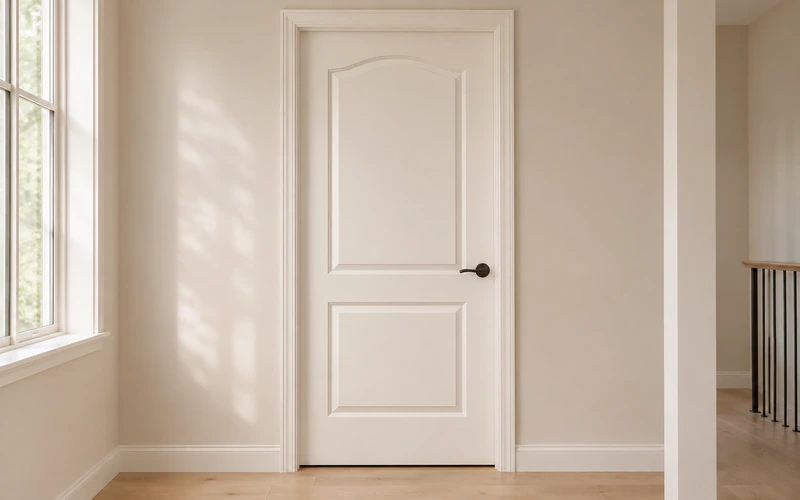
Door skins are the largest single use for HDF. A door skin is a thin HDF sheet pressed into a panel shape and then glued to a wooden door frame. HDF suits this job because the press holds sharp panel lines, the smooth face needs little sanding before painting, and the board stays flat over a wide area.
Typical thickness runs from 2.5 mm to 8 mm, with 3 mm the most common. SUMEC produces customized door skin HDF in buyer-specified sizes, mould patterns, and surface finishes.
HDF as a Laminate Flooring Core
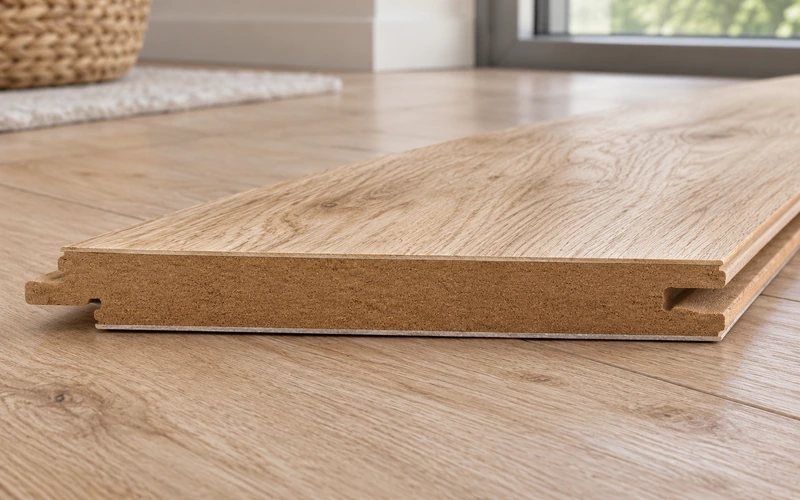
Laminate flooring uses HDF as its core layer. High density is what lets a milling machine cut a click-lock tongue and groove that stays tight after repeated assembly. A softer core would crumble at the locking edge.
The limitation is the same as before. A laminate floor tolerates a damp mop, but not standing water. Flooring buyers should check both density and 24-hour swelling on the mill report.
HDF in Furniture, Cabinets, and Wall Panels
Furniture factories use HDF for parts that must be thin, flat, and rigid, e.g., cabinet back panels, drawer bottoms, and mirror backing. Melamine-faced HDF adds a decorative layer for wardrobe interiors. HDF also suits slatted wall panels, pegboard, and CNC-carved screens, because the dense fiber cuts cleanly without a fuzzy edge.
How to Choose Quality HDF Board: A Buyer’s Checklist
Buyers should judge HDF on documented specifications first, then confirm with a physical check. Ask the supplier to state these points in writing:
- Density as a number in kg/m³, not a word like “high.”
- Thickness and tolerance, e.g., 3.0 mm ±0.2 mm.
- Panel size and squareness, with trim allowance included.
- Surface condition, e.g., sanded, primed, or melamine faced.
- Moisture grade, standard or moisture resistant.
- Formaldehyde grade, matched to the destination market.
- Certificates and test reports from a recognized third-party lab.
HDF formaldehyde emissions and certifications
Emission grade is a legal requirement, not a marketing extra. Markets accept different standards, e.g., E1 and E0 in Europe, ENF in China, and CARB Phase 2 or TSCA Title VI in the United States. SUMEC holds ISO 9001, FSC, CARB/EPA, and CE certification, and its panels can be produced to the grade the destination market requires. Buyers should request the current certificate number and check its validity date.
A physical check on arrival takes only a few minutes:
- Weigh a full sheet and compare it with the stated density.
- Look at a cut edge for voids or dark burn marks.
- Check flatness with a straightedge laid across the sheet.
- Feel the face for sanding lines or resin spots.
Before signing, confirm the commercial terms as well, e.g., minimum order quantity, lead time, and export packing.
FAQs
Is HDF waterproof?
No. HDF resists moisture but is not waterproof. It swells when water reaches unsealed edges or drill holes. Every cut edge needs paint or edge banding.
Is HDF stronger than MDF?
Yes, in surface hardness and bending strength. Higher density means fewer dents and better moulded detail. MDF is easier to machine on the edge and costs less.
Is HDF the same as hardboard?
Not exactly. Traditional hardboard uses a wet process bonded by natural lignin. Most HDF today is dry-process board bonded with resin, giving tighter thickness control.
Is HDF better than plywood?
It depends on the job. HDF offers a smoother face for painting. Plywood is lighter, holds screws far better, and carries structural load. HDF is not structural.
What thickness does HDF come in?
Most traded HDF runs from 2.5 mm to 8 mm, with 3 mm the most common for door skins. Standard panel size is 1,220 × 2,440 mm.
Can HDF be painted or laminated?
Yes. The dense, smooth face accepts primer, paint, melamine film, and PVC foil with little preparation. This is a main reason door plants choose HDF.
What is the difference between HDF and MDF door skins?
HDF skins are denser, so they hold sharper mould patterns and resist dents better. MDF skins cost less but show softer detail.
Conclusion
HDF is the right panel when a project needs a thin, hard, flat surface indoors, e.g., moulded door skins, laminate flooring cores, and painted furniture parts. It is the wrong panel for outdoor use, wet areas, and load-bearing frames, where plywood is the better answer.
For full specifications, certificates, and current product options, visit the SUMEC Building Material website, or reach the sales team through the contact page to request samples and a quotation.
Learn More About Our Products?
Contact Now