
SPC vs LVT vs WPC Flooring: A Buyer’s Guide to Choosing the Right Core
SPC, LVT and WPC flooring differ in one main way: the core. SPC flooring uses a rigid stone-plastic core, LVT uses a flexible PVC core, and WPC uses a foamed wood-plastic core. That one layer decides how each floor handles water, heat, heavy loads and foot traffic.
This guide comes from the technical team at SUMEC Building Material, a wood and non-wood panel manufacturer founded in 1978 that exports to more than 100 countries. It compares the three cores by structure, performance, cost and shipping. It also lists the specs, use classes and certifications buyers should confirm before placing an order, and matches each floor to the project types it suits best.
What Separates SPC, LVT and WPC Flooring? It All Starts With the Core
From above, these three floors look almost the same. They share the same top build: a UV coating, a clear wear layer and a printed décor film. The real difference sits under that film. The core sets the density, the stiffness, the feel underfoot and most of the price.
SPC Flooring: The Rigid Stone-Plastic Core
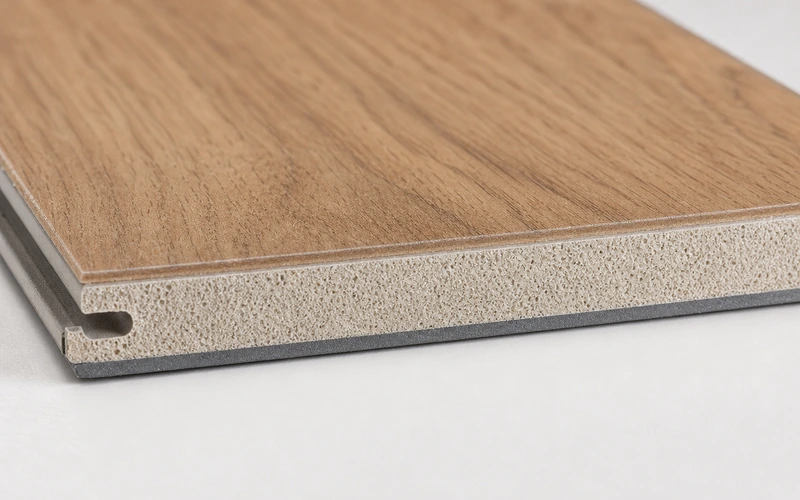
SPC stands for Stone Plastic Composite. Its core mixes limestone powder, PVC resin and stabilizers, which makes the plank dense and stiff. Boards usually run 3.5 mm to 7 mm thick, thinner than most WPC boards but heavier per square meter.
The stiff core barely expands or shrinks when a room heats up or cools down, and it resists dents from heavy furniture. Most SPC boards use a click system and float over the subfloor, so no glue is needed. Many also come with an IXPE or EVA pad attached to cut walking noise, as with SPC vinyl plank.
LVT Flooring: The Flexible PVC Core
LVT stands for Luxury Vinyl Tile. Its core is flexible PVC with calcium carbonate and plasticizers, and boards run about 2 mm to 5 mm thick. LVP is the same product cut into long plank shapes instead of tiles.
The flexible core feels warmer and softer than a stone core, and it holds very fine surface texture. That is why LVT carries the sharpest wood and stone prints. It comes in three install systems: dry-back, click and loose lay. There is one trade-off. A flexible board follows the shape of the floor under it, so any bump or dip in the subfloor will show through.
WPC Flooring: The Foamed Wood-Plastic Core
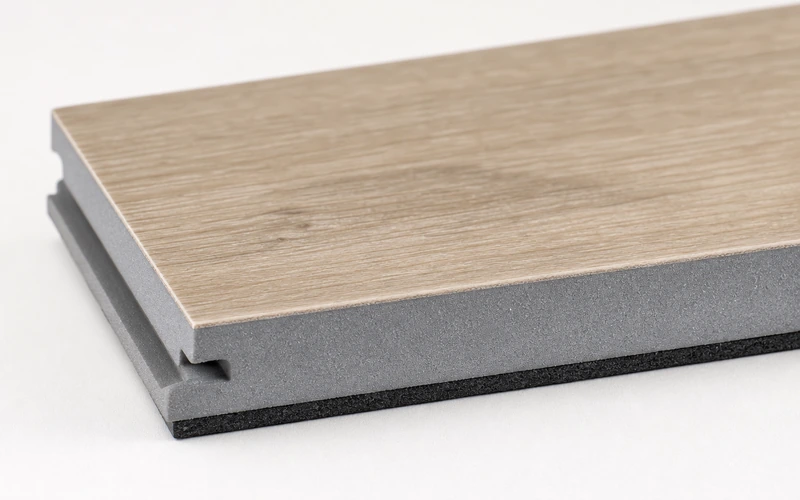
WPC stands for Wood Plastic Composite. Its core mixes wood flour, PVC resin, a foaming agent and stabilizers. The foaming agent creates tiny air bubbles inside the board, which make WPC lighter, softer and quieter than the other two.
WPC boards are the thickest of the three, at about 5.5 mm to 8 mm. They feel closest to real wood and absorb sound well. The same bubbles also lower the density, so WPC dents more easily under point loads such as chair legs and appliance feet.
SPC vs LVT vs WPC Flooring: Side-by-Side Comparison Table
The table below sets the three floors against the same specs, so buyers can compare them line by line.
| Spec | SPC Flooring | LVT Flooring | WPC Flooring |
| Core material | Limestone powder + PVC | Flexible PVC + calcium carbonate | Wood flour + PVC + foaming agent |
| Typical thickness | 3.5–7 mm | 2–5 mm | 5.5–8 mm |
| Relative density | Highest | Medium | Lowest |
| Waterproof core | Yes | Yes | Yes |
| Dimensional stability | Best | Good (best when glued) | Moderate |
| Dent resistance | Best | Moderate | Moderate |
| Comfort and sound | Firm; better with a pad | Warm and quiet | Softest and quietest |
| Install method | Click, floating | Dry-back, click or loose lay | Click, floating |
| Best fit | High traffic, wet rooms, underfloor heating | Design-led spaces, large glued spans | Low-traffic comfort areas |
| Relative cost | Medium | Low to medium | Medium to high |
These are typical category ranges, not product specs. Buyers should confirm exact figures on the datasheet for the item they are quoting.
Head-to-Head: How SPC, LVT and WPC Flooring Compare in Practice
The table shows the numbers, but not the trade-offs behind them. In short, all three cores are waterproof, so the real water risk sits in the joints and the install method rather than the core. SPC leads on dent and heat resistance, though wear layer thickness controls service life more than the core does. WPC clearly wins on comfort and quiet. The sections below explain when each trade-off actually matters.
SPC vs LVT Flooring: Rigid Core vs Flexible Core
This is the choice most projects come down to. A rigid SPC core bridges small dips in the subfloor and floats as a click floor, so site prep is faster and cheaper. A flexible LVT core does the opposite. It copies the base under it, so a glued LVT job needs a smooth, level screed.
That does not make LVT the weaker choice. On large open commercial spans, dry-back LVT is glued across the whole area. There is no floating movement and no expansion gap in the middle of the room, which is often the safer specification for malls and long corridors.
SPC vs WPC Flooring: Density vs Cushioning
Both are rigid-core floating floors, but they are built for opposite goals. WPC uses air to add comfort. SPC uses mineral filler to add strength. One gains softness and loses density; the other gains density and loses softness.
In practice, that shows up as dents. A WPC board handles daily footfall well, but a heavy sofa leg or a loaded trolley can leave a permanent mark. An SPC board of the same thickness takes that load with far less damage, and it also holds its size better in sunrooms and rooms with underfloor heating.
LVT Flooring vs WPC Flooring: Design Freedom vs Underfoot Comfort
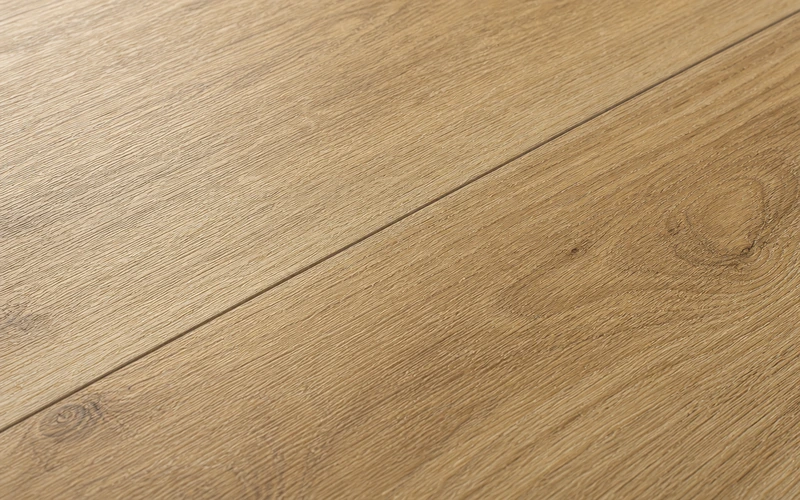
These two rarely compete for the same job. LVT is the design product. Its thin, flexible sheet supports the widest range of formats and finishes, including herringbone layouts, stone tiles and mixed-format designs. It is also the cheapest core of the three.
WPC is a comfort product sold at a premium. It suits buyers who want the feel of real wood without the water risk, so bedrooms, apartments and hotel rooms are its natural home.
Cost Comparison: What SPC, LVT and WPC Flooring Really Cost to Land
Price per square meter is only half the picture. Thickness and density decide how much floor fits in a container, and freight is charged on the container, not the square meter. A thin dry-back LVT can load close to twice the area of a 5 mm SPC floor in the same box. Once ocean freight is spread across that volume, the cheaper ex-works product is not always the cheaper landed product.
Lifetime cost matters just as much. A thin wear layer in a busy shop will scuff through in a few years, and replacing it means new material, new labour and closed trading days.
Before Placing an Order: Specs and Certifications to Check on SPC, LVT and WPC Flooring
Category names alone do not describe a floor. Two SPC boards of the same thickness can perform very differently once installed. The points below separate a floor that lasts from a floor that generates claims.
- Wear layer thickness. This clear top layer controls scratch life. As a rough guide, 0.3 mm suits homes, 0.5 mm suits commercial rooms, and 0.7 mm suits heavy-duty areas.
- Core formulation. For SPC, the balance of limestone to PVC sets both stiffness and brittleness. Too much filler makes boards crack at the click joint during installation.
- Use class. Specify by standard, not by adjective. EN ISO 10874 classes (e.g., 23, 33, 42) describe traffic level in a way both sides can verify.
- Dimensional stability. Tested to EN ISO 23999. A tight result is what prevents gaps at the seams and lifted edges on large floor areas.
- Locking system and backing. Ask for the joint pull strength, and confirm whether an IXPE or EVA pad is pre-attached, since that changes both the sound result and the install cost.
- Market certifications. Required documents differ by destination (e.g., CE marking to EN 14041, FloorScore, REACH). Missing paperwork can hold a shipment at customs.
Three Mistakes Buyers Make When Comparing SPC, LVT and WPC Flooring
Most flooring complaints trace back to a specification error, not a factory defect. Three mistakes come up again and again.
The first is judging durability by total thickness. An 8 mm board with a 0.3 mm wear layer will scratch faster than a 4 mm board with a 0.55 mm wear layer. Thickness affects feel and subfloor tolerance; the wear layer affects service life.
The second is treating WPC as an upgraded SPC. It is not a higher grade, only a different balance that trades density for comfort.
The third is writing specifications in adjectives. Terms like “heavy-duty” mean nothing in a contract. A use class, a wear layer figure and a stability result do.
How to Choose Between SPC, LVT and WPC Flooring by Project Type
The simplest way to decide is to start with the room, not the product. The list below maps common project types to the core that fits them best.
- Wet rooms (e.g., kitchens, bathrooms, laundry rooms): SPC, for its stable mineral core.
- High-traffic public spaces (e.g., shops, hotels, clinics): SPC, or dry-back LVT with a thick wear layer.
- Large open commercial spans: dry-back LVT, glued across the full area.
- Underfloor heating and sunrooms: SPC, which moves the least.
- Apartments needing sound control: WPC, or SPC with an attached IXPE pad.
- Design-led interiors and pattern layouts: LVT, for the widest choice of formats.
Buyers building a full range usually stock SPC as the volume line and LVT for design and glued commercial work. Both are covered in the flooring and wall panel product range.
FAQs
What is the main difference between SPC and WPC flooring?
The core. SPC uses a dense limestone-and-PVC core that resists dents and heat. WPC uses a foamed wood-and-PVC core that feels softer and quieter but dents more easily under heavy point loads.
Is SPC or LVT flooring better for commercial projects?
Both work, but for different layouts. SPC suits wet rooms and high-traffic areas as a floating floor. Dry-back LVT suits large open spans, because gluing removes floating movement across the whole area.
Is WPC flooring more waterproof than SPC flooring?
No. Both cores are waterproof and neither absorbs water. In wet rooms, joint quality and installation matter far more than core type for long-term water performance.
What wear layer thickness suits SPC, LVT and WPC flooring?
It depends on traffic, not on core type. Around 0.3 mm suits homes, 0.5 mm suits commercial rooms, and 0.7 mm suits heavy-duty areas such as shops and hotel lobbies.
Which flooring type gives the best container yield?
Thin dry-back LVT. Because it is only 2 mm to 3 mm thick, a container holds far more square meters than it does of 5 mm SPC, which lowers freight cost per square meter.
Conclusion
There is no single best core among SPC, LVT and WPC flooring. There is only the core that fits the room. SPC handles water, heat and traffic. LVT gives design freedom and a full-bond option for large commercial floors. WPC delivers comfort and quiet at a premium.
Two details decide more than the category name: the wear layer thickness and the true landed cost. Buyers who lock both down early avoid most disputes later. For help matching a specification to a project, technical documents and samples are available through SUMEC Building Material.
Learn More About Our Products?
Contact Now