
What is Blockboard? Construction, Uses & Comparison Guide
Blockboard is an engineered wood panel with a core of solid wood strips glued edge to edge and covered by wood veneers on both faces. It is light, stays flat over long spans, and holds screws well. Builders use it for furniture, doors, and shelves. Because it has face, core, and back layers, blockboard is often classified as a type of plywood.
This guide draws on SUMEC Building Material’s 40+ years of industry expertise since 1978 and its ISO 9001, FSC, CE, and CARB/EPA certified products. It explains how blockboard is made, its grades, pros and cons, and common uses. It also compares blockboard with plywood and MDF and gives a simple buying checklist.
What is Blockboard?
Blockboard is a wood panel made of three main parts: a solid wood strip core, a face veneer, and a back veneer. The core strips run along the length of the board. The veneers are laid across the strips at a right angle. This cross-grain layout helps the board resist bending and warping.
In the United States, the same product is often called lumber-core plywood. Blockboard is usually sold in 1220 × 2440 mm (4 × 8 ft) sheets. Common thicknesses include 12 mm, 15 mm, 18 mm, and 25 mm.
Blockboard offers several clear benefits for interior projects. Its main advantages are listed below:
- Light weight: The strip core makes blockboard lighter than many panels of the same thickness, such as plywood, MDF, and particleboard. This makes large sheets easier to carry and install.
- Stays flat over long spans: Long parts, such as bookshelves, tabletops, and wardrobe doors, resist sagging over time.
- Good screw holding: Screws grip firmly when they go into the solid wood strips.
- Smooth, wide surface: The veneer face accepts many finishes, such as paint, laminate, and decorative wood veneer.
Blockboard also has limits that buyers should know. Its main limitations are listed below:
- Moisture resistance depends on glue: Boards with interior glue can swell in wet areas, such as bathrooms, laundry rooms, and open balconies. Phenolic glue helps.
- Possible core gaps: Small gaps can form between strips. A screw that lands in a gap holds less weight.
- Edges need care: Cut edges may chip. Edge banding helps protect them.
- Lower load capacity than plywood: For heavy loads, plywood is usually the stronger option.
Blockboard Construction: What’s Inside a Blockboard Panel
Blockboard construction combines a solid wood core with thin outer layers. The quality of each layer and the way the layers are pressed together decide how the board performs. The two sections below explain the materials first and then the production steps.
Blockboard Core Strips, Face Veneers and Adhesives
A blockboard panel depends on three key materials: core strips, veneers, and glue.
The core strips are narrow pieces of light, fast-growing wood, such as poplar. They are dried before use, so they do not shrink or twist. The strips are placed side by side and glued into one slab by machine. Core species can vary by order.
The veneers are thin sheets of wood. Cross-band veneers can be placed over the core to add strength. Face and back veneers give the board its final look. Common face veneers include Okoume, Bintangor, Pencil Cedar, Sapele, and pine.
The glue holds every layer together. Urea-formaldehyde glue is used for dry indoor boards. Phenolic glue gives better water resistance. Low-emission glues help boards meet CARB P2 and EPA TSCA Title VI formaldehyde limits.
How Blockboard Is Manufactured Step by Step
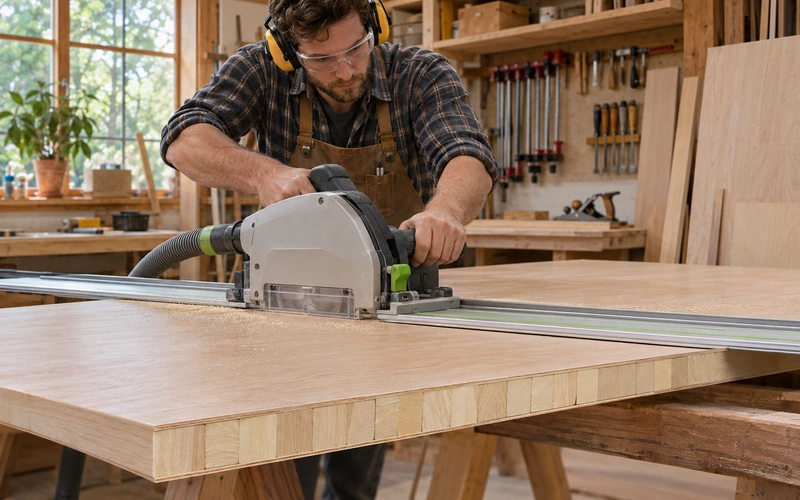
SUMEC Building Material produces wood panels in its mills in Eastern China. Its blockboard follows the main steps below:
- Raw material check: Workers inspect materials, such as poplar, hardwood, and face veneers, and sort them by grade.
- Pre-treatment: Core materials are edge-jointed and glued by machine.
- Core and layer assembly: Workers lay the core and layers on a production line.
- Cold pre-pressing: The stacked board stays in a cold press for at least 2 hours to take shape.
- Hot pressing: The board is pressed with heat for at least 1 hour to form a strong bond.
- Patching and sanding: Workers fill surface gaps. A sanding machine then makes the board smooth and even in thickness.
- Face and back veneering: Face and back veneers are glued on. The board is cold pressed for at least 1 hour and hot pressed again for at least 30 minutes.
- Cutting, inspection, and packing: Boards are cut to 1220 × 2440 mm and polished. They are then checked for defects, such as cracks, uneven density, and surface marks, before grading and packing.
Types and Grades of Blockboard
Blockboard types are defined mainly by glue grade and surface finish. The glue grade shows where the board can be used, while the surface shows how it will look. The table below compares the most common types:
| Type | Glue or Surface | Best For |
| MR (Moisture Resistant) grade | Moisture-resistant UF-based glue | Dry indoor furniture, doors, and wall panels |
| WBP (Weather and Boil Proof) grade | Phenolic glue | Indoor areas with higher humidity |
| Plain blockboard | Sanded veneer face | Painting, laminating, or custom finishing |
| Veneered blockboard | Decorative wood veneer face | Cabinets, wardrobes, and high-end furniture |
| Laminated blockboard | Laminate face | Office furniture and shop fittings |
A WBP glue line resists water much better than an MR glue line. Even so, the wood core can still absorb water through open edges. For this reason, all edges should be sealed, and boards should not stay wet for long periods.
What is Blockboard Used For? Common Blockboard Uses
Blockboard is mainly used in furniture and interior work where a light, flat, and wide panel is needed. Furniture makers, door factories, and interior contractors often choose it for the jobs listed below:
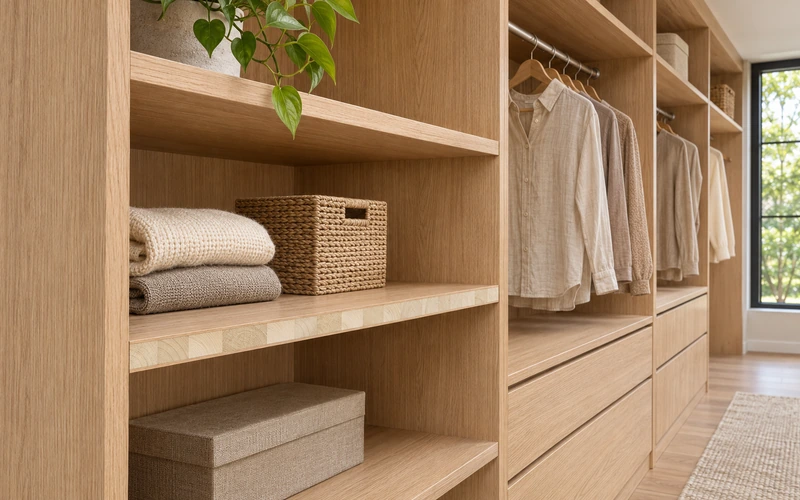
- Furniture and cabinets: Makers use blockboard for wardrobes, beds, and desks. 18 mm boards are a common choice for wardrobe sides and cabinet boxes.
- Doors and partitions: Blockboard keeps its shape over the full height of a door. It works well for flush doors, sliding doors, and room dividers.
- Long shelves and worktops: The strip core reduces sagging on long parts, such as bookshelves, display shelves, and study tables. Thicker 25 mm boards suit heavier tops.
- Wall panels and ceilings: The smooth face takes paint, laminate, or veneer, which suits decorative wall and ceiling panels.
- Shop fittings: Retail and exhibition projects use blockboard for counters, display units, and booth walls, because the panels are light and easy to move.
Blockboard vs Plywood vs MDF: Which Panel Is Right for You?
Blockboard, plywood, and MDF often compete for the same interior jobs. Each panel has a different core, so each one performs best in different places. The table below gives a quick overview:
| Property | Blockboard | Plywood | MDF |
| Core | Solid wood strips | Cross-layered thin veneers | Pressed wood fibers and resin |
| Weight | Light | Medium | Heavy |
| Strength | Stiff along its length | High in all directions | Lower |
| Screw holding | Good in strips, weak at gaps | Good on faces and edges | Fair on faces, weak on edges |
| Moisture | Depends on glue; WBP is better | Good with WBP glue | Poor in standard grades |
| Surface | Smooth veneer | Veneer with wood grain | Very smooth, paints well |
| Best for | Doors, long shelves, wardrobes | Load-bearing and damp areas | Painted fronts and carved designs |
The two sections below look at each comparison in more detail.
Blockboard vs Plywood
Blockboard and plywood both have veneer faces, but their cores are different. Plywood is built from many thin veneers with the grain crossing at each layer. This gives plywood even strength in all directions and steady screw holding on every edge. With WBP glue, plywood also handles damp areas better.
Blockboard is lighter and stays straighter over long spans. It suits wardrobe doors, long bookshelves, and wide tabletops. SUMEC plywood is often the better choice for kitchen cabinets, heavy furniture, and other load-bearing parts.
Blockboard vs MDF
MDF is made from wood fibers mixed with resin and pressed into dense sheets. It has no grain and a very smooth surface, so it paints well and is easy to carve. However, standard MDF is heavy, holds screws poorly at the edges, and swells when it gets wet.
Blockboard is lighter, stronger, and holds screws better. Many furniture makers combine the two. They use blockboard for the frame and MDF for painted door fronts.
How to Choose High-Quality Blockboard
High-quality blockboard is chosen by checking its specifications, not just its product name. Buyers can use the checklist below before placing an order:
- Glue grade: Choose MR grade for dry rooms and WBP grade for more humid rooms.
- Core quality: Ask for a cut sample. The strips should be tight and even, with no large gaps or rot.
- Face veneer: Check the veneer species and grade. The face should be free of cracks, overlaps, and rough patches.
- Thickness and flatness: Measure each board at several points. The readings should be close, and the board should lie flat.
- Size: Confirm the sheet size. 1220 × 2440 mm is standard, and some suppliers offer custom sizes.
- Certification: Look for proof of quality and safety, such as ISO 9001, FSC, and CARB P2 or EPA compliance.
Supplier quality control matters as much as the board itself. For example, SUMEC blockboard goes through a pre-shipment inspection system that starts as soon as an order is confirmed. With over 500,000 m³ of annual capacity and 99% on-time delivery, SUMEC supports steady supply for large orders.
FAQs
Is blockboard waterproof?
It depends on the glue grade. MR grade suits normal indoor humidity. WBP grade with phenolic glue resists moisture much better, but its edges should be sealed and long soaking avoided.
Is blockboard stronger than plywood?
No, plywood is usually stronger overall because its cross-layered veneers spread loads in all directions. However, blockboard is stiffer along its length and sags less on long shelves.
What is blockboard made of?
Blockboard is made of a solid wood strip core, face and back veneers, and glue. The core is usually light wood, such as poplar. Face veneers include Okoume, Bintangor, and Sapele.
What thickness of blockboard is best for furniture?
18 mm is the most common thickness for furniture. It suits wardrobes, cabinets, and shelves. Use 25 mm for heavy tops and 12–15 mm for light partitions.
Conclusion
Blockboard is the right choice when a project needs a light, flat, and wide panel for furniture and interior work. Its strip core stays straight over long spans, and its veneer faces accept many finishes. Plywood is often better for heavy loads and damp areas, while MDF is better for smooth painted surfaces. Checking the glue grade, core quality, and certification helps buyers get reliable boards. For blockboard specifications or a quote, buyers can contact SUMEC Building Material.
Learn More About Our Products?
Contact Now