
Marine Grade Plywood: Uses, Advantages, Types
Many builders and factories use marine-grade plywood for wet-condition jobs. It holds up well under high humidity and repeated water contact. But it is not fully waterproof. Workers still need to seal its edges and surfaces.
This article covers key facts about marine-grade plywood. You will read about its build features, main benefits, real-world uses, plywood types, buying checks, plus storage and finishing advice.
Table of Contents
What Is Marine-Grade Plywood?
According to WoodenBoat Magazine, marine-grade plywood is high-grade hardwood plywood built for damp or water-exposed work. Many buyers confuse it with regular exterior plywood.
It uses WBP phenolic glue that passes strict boiling-water tests, and its inner core stays void-free. Every wood veneer comes with tight limits on knots and splits. It is important to understand that only the glue bond resists water separation. The wood material itself will still absorb water. Unsealed raw panels will rot inside wet environments, so builders must add protective coats to reach a long service life.
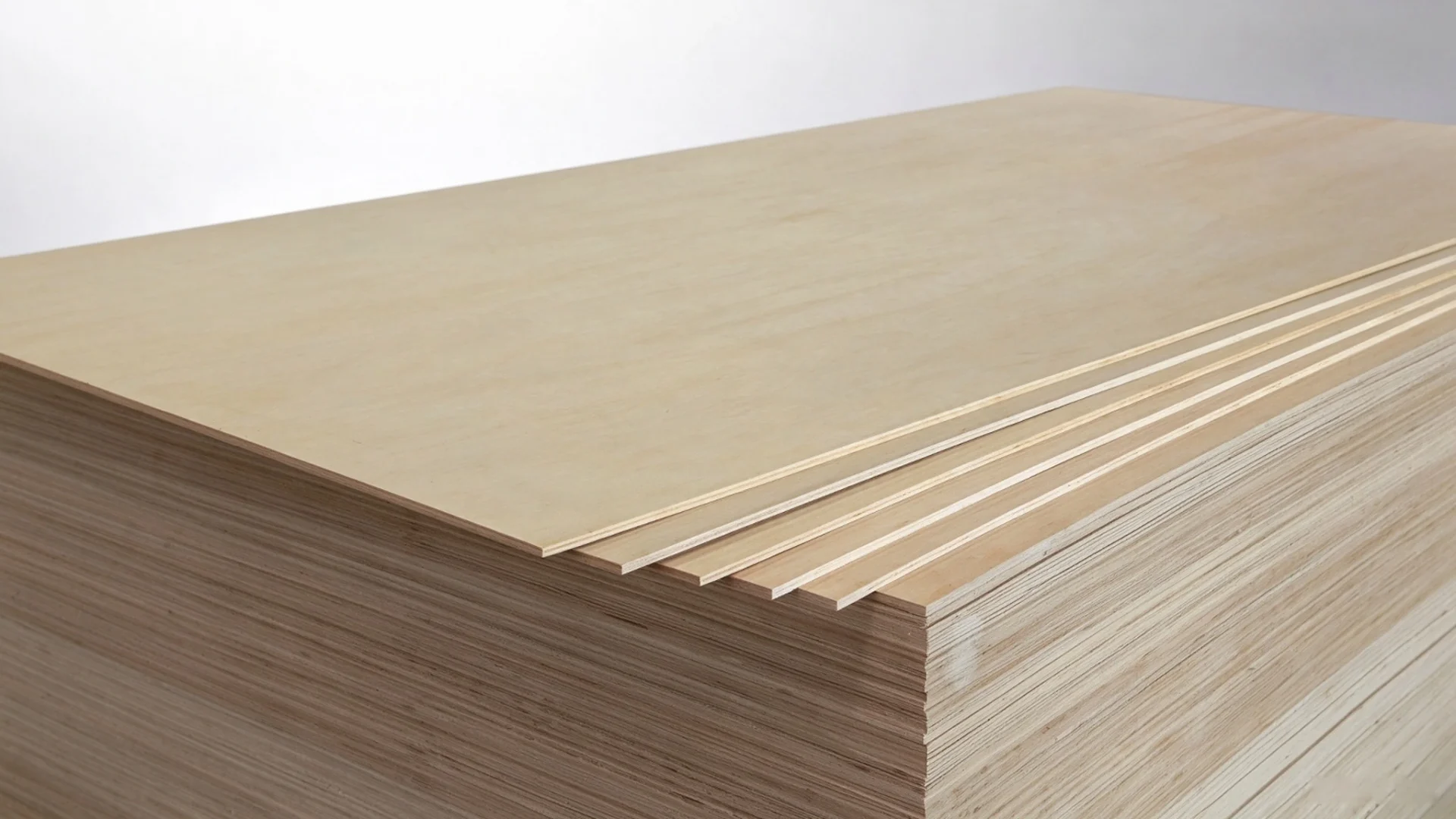
Source: SUMEC Building Material Gallery
Core Construction Features of Marine-Grade Plywood
Each construction detail shapes real-world site performance, based on the Woodexy industry guide. Genuine marine-grade plywood follows strict production rules that separate it from cheap exterior plywood.
- Void-free core: No hidden gaps inside sheets. Voids trap moisture and create weak spots, so manufacturers reject veneers with holes.
- WBP phenolic adhesive: This weather-and-boil-proof glue holds layers through damp exposure, meeting EN 314-2 Class 3 bond standards.
- High-grade hardwood veneers: Large knots and cracks get removed from both surface and inner layers.
- Cross-grain layered structure: Each veneer turns 90 degrees. This design greatly lowers warping when humidity changes.
Cheaper exterior plywood often allows core gaps and low-quality inner veneers. It cannot match the long-term wet-environment performance of true marine-grade plywood.
Key Advantages of Marine-Grade Plywood
Marine-grade plywood brings clear benefits for projects exposed to moisture.
- Strong delamination resistance: The WBP phenolic glue bond stops layers from splitting during repeated wet-dry cycles.
- Good dimensional stability: Cross-grain hardwood construction keeps sheets flat. It warps far less than ordinary plywood in high-humidity areas.
- Favorable strength-to-weight ratio: Hardwood delivers solid strength without adding too much weight. This is very helpful for boat-building and light outdoor structures.
- User-friendly finishing performance: Clean veneer surfaces take epoxy, paint and varnish well. Workers can cut and shape panels for custom sizes.
- Long service life with proper sealing: With full edge and surface protection, panels can last 10-25 years for marine and outdoor work, per Woodexy industry reports.
It also has one main downside. Marine-grade plywood costs much more than regular exterior plywood. It offers no practical benefit for fully dry indoor projects.
Marine-Grade Plywood: Main Uses
Marine-grade plywood sees wide adoption across building and manufacturing fields, according to WoodenBoat Magazine practical project reports. Thanks to its tough glue bond, stable hardwood build and good finishing performance, different industries put this plywood to work on jobs facing damp and water splash. Below are its main application sectors.
Key Application Sectors
| Industry Sectors | Main Use Purpose |
| Boat & marine craft building | Build boat hulls, bulkheads and small water-craft parts |
| Dock & coastal construction | Make pontoon frames, dock sub-structures for waterside sites |
| High-moisture building work | Wet-area cabinet frames, bathroom and laundry structural panels |
| Outdoor furniture production | Build outdoor table, bench frames under rain and sun exposure |
| Industrial & vehicle fit-out | Camper and trailer wall / floor panels, heavy-duty formwork |
Typical On-Site Project-Level Use-Cases of Marine-Grade Plywood
Workers cut marine-grade sheets for small boat shells and inner bulkhead parts. The void-free core keeps hidden water damage from forming inside boat structures. It also works well as supporting material beneath dock decking, where panels face constant water splash and moist coastal air to lower frequent replacement work.
For construction projects, builders use it to make base frames for bathroom and laundry cabinets. Properly sealed panels hold up against ongoing steam and moisture. Furniture factories rely on it for outdoor bench and table inner frames, though full surface and edge sealing remains required before outdoor installation. It also fits camper and trailer interior panels, standing up to dew, splash and shifting outdoor weather inside mobile units.
To sum up, marine-grade plywood handles many damp-exposed factory and building tasks. It delivers reliable performance when users complete proper sealing work.
Different Types of Marine-Grade Plywood
Buyers encounter multiple marine-grade plywood options on global timber markets, based on Woodwiki technical guide notes. Each type fits different project goals.
- Okoume marine plywood: Light-weight and easy to bend. Sourced from African hardwood. Best for small light boats and curved parts where weight control matters. It shows soft pink wood grain.
- Meranti marine plywood: Higher density and better impact resistance. From Southeast Asia. More cost-effective for bulk orders. Widely used for work boats, dock parts and outdoor furniture. It has reddish-brown tones.
- MDO / HDO film-faced marine plywood: Factory-applied surface films. MDO gives smooth matte finish; HDO offers hard glossy cover. Both resist scratches and UV rays for formwork and exposed outdoor panels.
Face grades further define quality and cost:
- AA grade: Nearly zero surface defects, for highly-visible finished boat components
- AB grade: One clean face, minor marks on reverse side; balances appearance and budget
- BB B grade: For hidden structural parts where surface look is not important
Under BS 1088:2018 standard, there are standard and lightweight marine-grade classes. Lightweight sheets reduce total weight for non-heavy-load watercraft. Buyers need to select the correct class based on load requirements. Wood species, film facing and face grade all change price and real-world performance.
Important Buying Checks for Marine-Grade Plywood
Buyers need to check key quality points before placing bulk orders, according to BSI timber buying guidance and WoodenBoat Magazine procurement tips. These checks prevent expensive on-site failures caused by low-grade counterfeit material.
| Check Item | Key Requirement | Practical Impact for Factories |
| Certification standard | Meet BS 1088:2018 or hold Lloyd’s Register approval | Many low-grade sheets print fake BS1088 stamps. Real third-party certificates prove true marine-grade quality. Request batch test reports. |
| Core condition | Fully void-free core, no inner gaps | Hidden voids trap water. They cause early delamination and hidden structural failure. Inspect cut sheet edges visually. |
| Glue type | Confirm WBP phenolic adhesive (EN 314-2 Class3) | Non-WBP glue will separate under damp conditions. Ask suppliers for glue specification documents. |
| Veneer face grade | Match AA / AB / BB-B grade for your use case | Higher face grades cost more. Hidden structural parts can use lower BB-B grade to save budget. |
| Batch documents & panel appearance | Valid test certificate; flat sheets, no warping | Warped panels create installation trouble. Official papers confirm each batch meets stated marine-grade rules. |
In short, buyers should focus on real certification, void-free core, WBP glue, face grade and batch paperwork. These checks help purchase stable-quality marine-grade plywood for damp-exposed projects.
Marine-Grade Plywood Storage Cutting and Finishing Best Practices
Marine-grade plywood still needs careful handling. Poor storage or finishing will shorten its service life, as noted in Woodexy construction notes.
- Storage requirements Store sheets flat and elevated off ground inside dry covered spaces. Keep panels away from rain and direct ground moisture. Give air flow between stacked sheets. Let plywood acclimate 48-72 hours to site humidity before cutting or installation.
- Cutting requirements Use sharp wood-cut saw blades. Pre-drill screw holes near edges to stop wood splitting. Every fresh cut opens raw wood edges. Raw edges become main entry point for water damage.
- On-site finishing rules Seal all cut edges, drill holes and both panel faces. Epoxy gives best water protection for marine jobs. For outdoor work, add UV-resistant paint or marine varnish over epoxy finish. Re-check and repair finish coats every 1-2 years for long-term outdoor exposure.
To sum up, good flat-dry storage, careful cutting and full sealing are critical. Even top-rank BS 1088 marine plywood fails fast if cut edges stay raw and unprotected.
FAQ
Q1: Is marine-grade plywood 100% waterproof?
A: No. Its WBP glue resists water separation, but raw wood still soaks up water. You must seal edges and full surfaces with epoxy or marine paint. Un-sealed sheets will rot in wet environments.
Q2: What standard should I look for when buying marine plywood?
A: BS 1088:2018 is widely-used global marine plywood standard. Lloyd’s Register third-party approval adds extra trust. Do not trust printed stamps alone. Always ask for batch test documents.
Q3: What is the difference between marine-grade plywood and regular exterior plywood?
A: Exterior plywood may allow inner core voids and lower-quality inner veneers. True marine-grade plywood needs void-free core, strict veneer rules and proven WBP phenolic glue. Exterior plywood works for covered outdoor jobs, but not for boat hull or long-term water-splashed structures.
Q4: Okoume or Meranti, which marine plywood should I pick?
A: Choose Okoume when low weight matters, such as small light boats. Choose Meranti for higher impact resistance and better bulk-order cost-performance for docks and work-boat projects.
Q5: Can I skip edge sealing for marine-grade plywood?
A: Never skip edge sealing. Fresh-cut raw edges soak water very fast. Water enters inner wood layers and leads to rot and glue-line failure, even for genuine BS 1088 marine-grade plywood.
Conclusion
Marine-grade plywood is a trusted material for damp-exposed building and marine craft projects. Its WBP phenolic glue, void-free hardwood core and cross-grain build deliver stable performance under wet-dry cycles. It serves boat building, dock construction, wet-area joinery, outdoor furniture and vehicle fit-out work.
Different wood species and face grades give buyers choices for weight, visual look and project budget. Buyers need to verify real certification, void-free core and WBP glue before bulk purchase. Fake “marine-label” plywood brings high hidden risk for site projects.
Remember one key point. Marine-grade plywood glue is water-resistant, but raw wood is not. Proper flat-dry storage, careful cutting and full sealing for all edges and surfaces decide its real service life. When users select, store and finish panels correctly, marine-grade plywood brings long-lasting results for high-moisture projects.
Learn More About Our Products?
Contact Now