Analysis on Production, Operation and Upgrading Trends of Blockboard Factories
As a core base material widely used in home decoration, furniture manufacturing and engineering renovation, blockboards have formed a large-scale and clustered factory production pattern supported by a mature industrial system. At present, domestic blockboard factories show an obvious hierarchical development trend, with large-scale standardized manufacturers coexisting with medium and small processing plants, featuring huge differences in production modes, quality control standards and production efficiency. Driven by the escalating market demands for environmental performance, structural stability and customized products, as well as continuous fluctuations in raw material and supply chain conditions, blockboard manufacturers are phasing out extensive production modes and entering a critical transformation period focused on process optimization, quality improvement and lean production, driving profound structural upgrades across the industry.
In terms of production capacity and industrial layout, the blockboard industry boasts a huge overall capacity base with steadily improving capacity concentration. In the early stage of industrial development, the market was dominated by small and medium-sized processing factories with low production thresholds, simple equipment and scattered capacity, which mainly produced standardized plain boards and led to severe product homogenization. After years of industrial reshuffling, backward and inefficient production capacity has been gradually eliminated. Large-scale manufacturers continue to expand production and adopt automated production lines for mass manufacturing, effectively reducing unit production costs. A distinct hierarchical pattern has taken shape in the industry: large factories focus on the mid-to-high-end market, specializing in environmentally modified boards, customized veneered boards and functional blockboards, while small and medium-sized factories target the mass market with cost-effective standard products for affordable home decoration and conventional furniture manufacturing, forming differentiated and sustainable market niches.
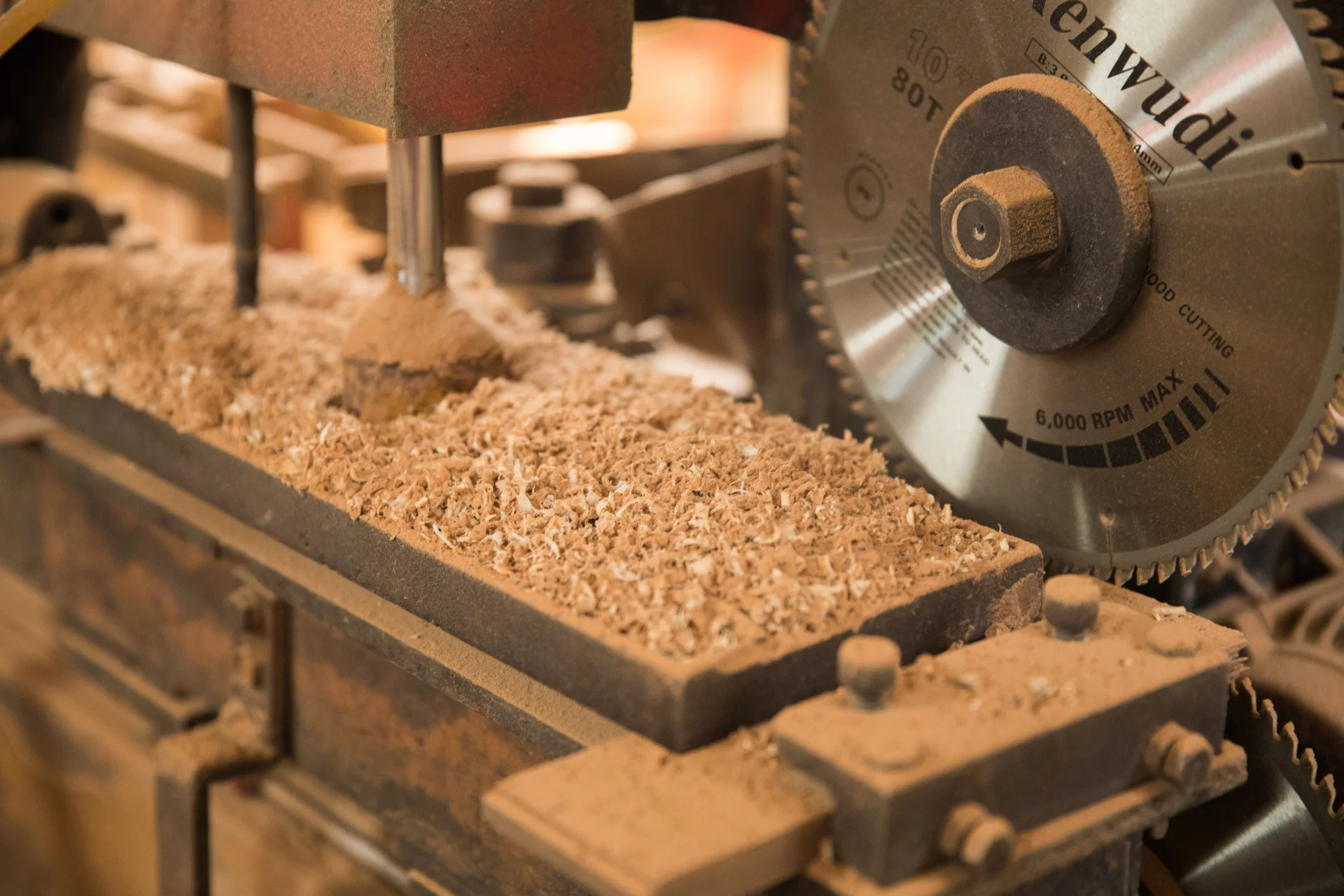
The gap in production processes and equipment configuration constitutes the core factor that differentiates product competitiveness among manufacturers. Traditional small factories adopt simplified production procedures and semi-automatic equipment, with heavy manual participation in key processes such as wood strip splicing, hot pressing and sanding. This easily causes uneven splicing gaps, unsmooth board surfaces and inconsistent glue coating, resulting in common quality defects including board deformation, degumming and weak nail holding power. In contrast, modern standardized factories realize full-process automated operation, covering log cutting, core board splicing, intelligent glue application, constant-temperature hot pressing, precision sanding and quality inspection sorting. Full equipment-based precision control greatly boosts production efficiency and ensures consistent structural stability of finished boards. Furthermore, advanced manufacturers widely adopt low-formaldehyde and formaldehyde-free adhesive systems and optimize hot pressing temperature and duration parameters, reducing harmful substance emissions from the production source to meet domestic and international environmental requirements.
Raw material management and cost control capabilities have become core barriers for the sustainable operation of blockboard factories. Wood cores, veneers and adhesives account for more than 70% of the total production cost. Most small and medium-sized factories rely on scattered raw material procurement channels without stable supply chain support, making it difficult to control the moisture content and grade of raw materials. This leads to unstable product quality across batches and weak risk resistance against raw material price fluctuations. In comparison, leading large-scale factories have established stable raw material procurement and warehousing systems. They conduct moisture conditioning and balanced curing treatment on wood materials to precisely control board moisture content, effectively avoiding subsequent cracking and deformation. Meanwhile, they improve wood utilization rate and reduce energy consumption through graded raw material utilization, residual material recycling and intelligent energy management, effectively offsetting the rising costs of raw materials and labor.
Inadequate quality control systems and non-standardized production remain the key shortcomings of small and medium-sized manufacturers. In the absence of unified refined industrial production standards, some small factories cut costs by simplifying production procedures, adopting low-quality auxiliary materials and shortening wood curing cycles. This results in uneven product quality in the low-end market and damages the overall industry reputation. In the quality inspection link, most small factories only rely on manual visual inspection, which cannot accurately detect core indicators such as formaldehyde emission, internal hollowing and bonding strength, leading to unstable product qualification rates. In contrast, leading factories implement full-process quality control, with strict inspections covering raw material warehousing, in-process sampling and finished product testing. Equipped with professional testing equipment, they guarantee stable performance of each product batch, meeting the stringent acceptance standards of high-end home decoration and export trade.
Against the backdrop of industrial development, the upgrading direction of blockboard factories has become increasingly clear. In terms of production capacity, inefficient and substandard scattered capacity will continue to be phased out, and production capacity will further concentrate on large-scale and standardized factories. In terms of technology, automated and intelligent equipment including precise glue control, constant-temperature pressing and intelligent sorting systems will be widely popularized to enhance product stability and environmental performance. In terms of products, manufacturers are transforming from mass production of single plain boards to customized functional products with moisture-proof, flame-retardant and pre-finished veneer features, enriching their product portfolios. In addition, lean management, green production and full-link quality control will become core competitiveness, helping manufacturers escape low-price homogeneous competition and adapt to diversified demands from domestic high-end markets and overseas trade markets with high-quality products.
Overall, the blockboard manufacturing industry is in a pivotal stage of structural transformation and upgrading. The extensive production model is no longer adaptable to market development needs. Only by continuously optimizing production processes, improving quality control systems, strictly managing raw material quality and promoting green and lean production can manufacturers break through development bottlenecks, consolidate long-term competitive advantages in domestic and overseas markets, and drive the entire blockboard industry toward high-end, standardized and high-quality development.