
China’s Particleboard Industry: Transition to High-Quality Development
As a core category in China’s wood-based panel family, the particleboard industry is standing at a crucial juncture of in-depth adjustment and transformation. After decades of rapid expansion, the industry has made considerable progress in production capacity, technological equipment and application fields, and has become the world’s largest particleboard production and consumption market. However, under the multiple pressures of the real estate market adjustment, stricter environmental protection standards and intensified internal competition, the industry is moving away from extensive growth and exploring a high-quality and sustainable development path through supply-side reform, technological innovation and green transformation.
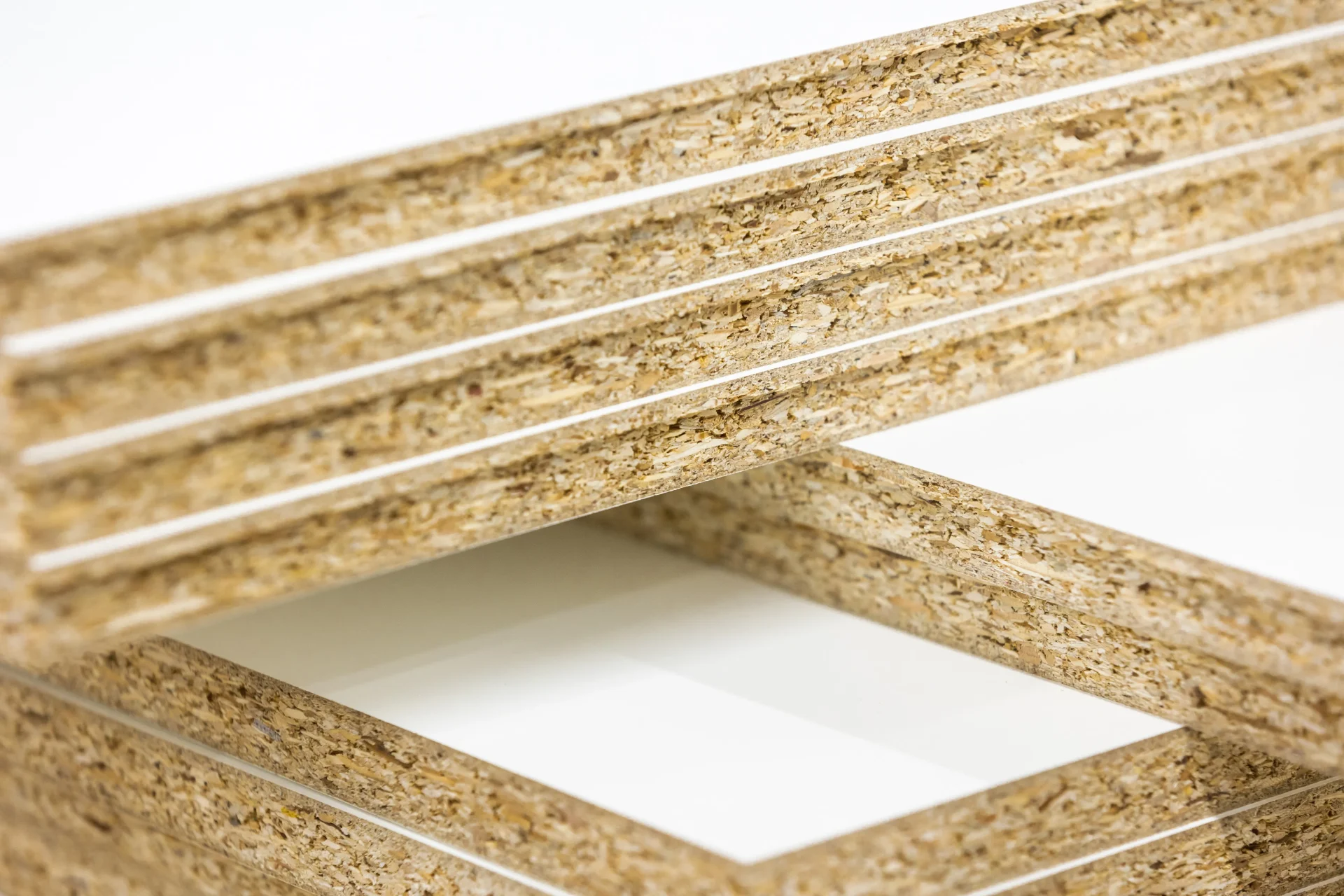
China’s particleboard industry has formed a large-scale and concentrated industrial pattern, while facing the prominent contradiction of unbalanced supply and demand. By the end of 2023, the total national particleboard production capacity had reached 78.5 million cubic meters, with annual output remaining at a high level and the overall market scale expanding steadily. In terms of regional distribution, production capacity shows a high degree of agglomeration, with the three core regions of East China, South China and Southwest China accounting for more than 68% of the total. Some provinces have become the main carriers of new production capacity by virtue of their resource advantages. In terms of product structure, traditional homogeneous particleboard still dominates, while the production capacity of special plates such as oriented strand board (OSB) is expanding rapidly, and continuous flat pressing technology has become the industry mainstream. On the application side, relying on advantages such as high cost performance and uniform structure, particleboard accounts for more than 80% of the application in the custom furniture field, and is also steadily expanding to prefabricated buildings, packaging and other fields. However, the concentrated release of new production capacity coupled with the slowdown in downstream demand has led to a phased overcapacity in the industry. The spread of price wars has severely compressed the average profit margin of the industry, leaving a large number of small and medium-sized enterprises in losses, and the industry has entered a period of reshuffling.
The upgrading of environmental protection policies has become the core engine driving the transformation of the particleboard industry. Starting from June 1, 2026, the new national standard GB 18580-2025 will be fully implemented, incorporating E0 grade into the mandatory national standard for the first time, requiring decorative wood-based panels to meet stricter formaldehyde emission limits and forcibly eliminating non-compliant products. This strictest-ever environmental protection standard has directly forced enterprises to eliminate backward production capacity, upgrade production processes and adhesive systems. Formaldehyde-free adhesives and biomass adhesive technologies have rapidly penetrated, and ENF grade ultra-environmentally friendly products have moved from high-end niche to large-scale mass production. At the same time, the “dual carbon” strategy has promoted the industry’s transformation to low-carbon manufacturing. Energy conservation, emission reduction, clean production and waste recycling have become the industry standard, and green board certification and product carbon labels have gradually become popular, promoting the green upgrading of the industry.
Technological innovation and changes in market demand have dual-driven the industry to improve quality and efficiency and expand space. On the production side, intelligent manufacturing, AI quality control and digital twin technologies have been gradually applied, significantly improving the automation and intelligence level of production lines, and effectively improving production efficiency and product stability. On the raw material side, facing the shortage of wood resources and rising costs, the industry has actively expanded agricultural and forestry residues such as bamboo and straw as alternative raw materials, effectively reducing dependence on logs and realizing high-value utilization of resources. On the product side, functional particleboards such as fire-proof, moisture-proof and anti-bacterial have become research and development hotspots, and the performance of high-density and high-strength products has continued to break through, gradually extending to high-end application fields. In terms of market demand, the renovation of existing houses and the construction of affordable housing have formed a stable domestic demand support. Consumption upgrading has promoted the increase in the proportion of mid-to-high-end environmentally friendly products. At the same time, the export market has continued to exert force, with strong demand in RCEP and “Belt and Road” countries relying on cost performance advantages, effectively digesting excess production capacity.
China’s particleboard industry is facing multiple challenges in the transformation process, and the road to breakthrough is long and arduous. High raw material costs and unstable supply chains are the primary pressures. The limited domestic wood resources have led to a high degree of external dependence in the industry. Fluctuations in international wood trade, rising transportation costs and rising prices of auxiliary materials have further squeezed the profit space of enterprises. Homogeneous competition and low-price involution are still chronic problems in the industry. Most enterprises are concentrated in the mid-to-low-end market, lacking brand and technological barriers. vicious competition has led to insufficient investment in innovation and uneven quality, hindering the overall upgrading of the industry. In addition, small and medium-sized enterprises are under great pressure to transform. Environmental protection, energy consumption and other standards continue to rise, increasing investment in technological transformation and certification. However, small and medium-sized enterprises are lacking in funds, technology and talents, facing the risk of elimination or integration. At the same time, the increase in international trade barriers has also brought uncertainty to export growth.
In the future, China’s particleboard industry will accelerate the shift from “scale expansion” to “quality and efficiency improvement”, ushering in a fundamental change in the development model. Industry integration will continue to accelerate. Under the pressure of environmental protection and costs, backward production capacity will be eliminated at an accelerated pace. Advantageous enterprises will expand their market share through mergers and acquisitions and capacity expansion. It is expected that the market share of leading enterprises will increase significantly in the next 3-5 years, and the characteristics of industrial clustering will become more obvious. Greenization, functionalization and high-endization will become the mainstream development direction of the industry. Formaldehyde-free and low-carbon products will become the market standard, the proportion of functional and special-purpose plates will increase significantly, and products will upgrade to high-value-added and customized directions. Intelligent manufacturing and circular economy will become the core competitiveness of enterprises. Digitization and intelligence will cover the entire production process, the recycling rate of raw materials will continue to increase, forming a circular industrial system with efficient resource utilization and environmental friendliness. The internal and external dual circulation will drive the steady growth of the industry. The domestic demand side will be supported by the renovation of existing houses and the promotion of green building materials in rural areas, while the external demand side will steadily expand relying on technological and cost advantages. It is expected that the industry market scale will exceed 90 billion yuan by 2030, gradually realizing the leap from a major particleboard country to a strong one.