
What Is A Particle Board: A Comprehensive Guide To Composition, Properties, And Uses
Particle board is an engineered wood panel made by hot-pressing wood waste — sawdust, chips, and shavings — with synthetic resins such as urea-formaldehyde (UF), MUF, or MDI. The mat is compressed at 180–220°C under 35 kg/cm² to form a flat panel with a density between 600 and 700 kg/m³.
Drawing on manufacturer specifications and global compliance standards (CARB Phase 2, EPA TSCA Title VI, EN 13986), this guide explains the raw materials, mechanical properties, primary applications (RTA furniture, cabinetry, sub-flooring, door cores), and the four formaldehyde emission grades that govern international sourcing.
How Is This Engineered Wood Panel Manufactured?
Factories make particle board by mixing wood waste with man-made resins and specific chemical additives. Machines layer this mixture into a flat mat. A continuous press applies high heat and pressure to form a solid panel.
Production relies on three main parts to turn raw waste into solid panels:
- Wood Core Materials: Sawmill shavings, wood chips, and plant fibers like bagasse.
- Man-Made Resin Binders: Urea-Formaldehyde (UF) for dry conditions, or safe MDI resins.
- Continuous Hot-Pressing: Heat and pressure systems press the mat into stiff boards.
Wood Core Materials And Geometry
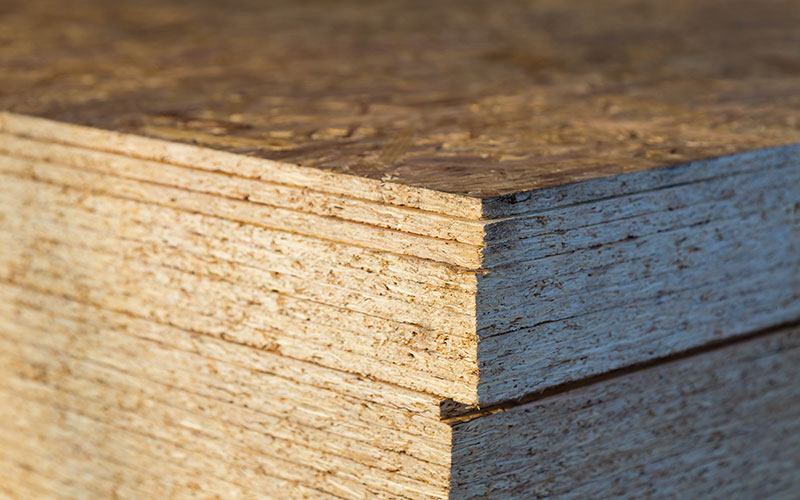
Builders make the core using a clear three-layer structure. The outer face layers use fine wood fibers. The inner core layer uses larger wood shavings.
This specific layering method controls the strength of the final board. Fine top layers give a completely flat outside surface. Coarse core layers provide inside bending strength.
Factories process raw sawdust and recycled wood chips from factory waste. Factories dry the raw wood materials before mixing.
Raw wood chips hold an average of 50% water. Large dryers reduce this water level to 2% to 4%. Correct water levels stop steam bubbles during the hot press stage.
Synthetic Resin Binders
Man-made resin glues bond the wood bits together permanently. The specific resin type controls the water resistance and safety class of the board.
Urea-Formaldehyde (UF) resin leads standard indoor board production. UF provides high dry strength at low making costs. Standard UF boards need strictly dry indoor spaces.
Melamine-Urea-Formaldehyde (MUF) resin makes water-resistant boards. MUF bonds resist damage from high air moisture.
MDI acts as a resin with zero added formaldehyde. MDI reacts chemically with wood moisture to form strong polyurethane bonds. MDI panels earn zero-added-formaldehyde (NAF) safety ratings.
Functional Chemical Additives
Chemical additives change specific physical traits of the final panels. Wax mixes provide short-term liquid water resistance. Builders add paraffin wax at 1% of the dry wood weight. The wax coats wood bits and slows water uptake.
Special chemicals reduce gas release in the final product. These chemical catchers bind with free formaldehyde molecules before they leave the panel.
Fire-safe grades need special chemical treatments. Builders add phosphate fire stoppers to the resin mix. These chemicals stop the burning process during a fire.
The Continuous Hot-Pressing Process
Constant hot presses pack the loose mat into a solid board. The machines apply heat and pressure at the same time.
The pressing process follows three main steps to ensure board density:
- Mat Formation: Machines spread the glued wood bits onto a moving steel belt in three layers.
- Pre-Compression: Cold presses remove extra air from the mat to stop bursts during heating.
- Thermal Curing: Heated belts press the mat while baking the resins into strong plastics.
Press heat ranges from 180°C to 220°C. The high heat cures the resin binders fast.
Hydraulic pressure reaches 35 kilograms per square centimeter. This pressure compresses the wood parts to the target thickness.
Cooling stations steady the panels right after pressing. Factories store the hot boards in large coolers for 24 hours. Proper cooling stops inside cracks and bending.
What Are The Primary Mechanical And Physical Properties?
Key material traits include uniform density, uniform surface smoothness, and solid inside bond strength. The board keeps its shape well in dry spaces. Load-bearing strength remains lower than solid wood.
Density Profile And Internal Bond Strength
Board density measures 600 to 700 kilograms per cubic meter. The constant pressing creates a clear density shift. The outer faces have higher density than the inside core.
Inside bond strength measures the force holding the pieces together. Standard particle board reaches an inside bond strength of 0.40 Newtons per square millimeter.
The boards contain no grain direction, knots, or empty spaces. Pulling strength remains completely even across all board sizes.
Surface Smoothness And Machinability
The fine top parts create a fully flat outside finish. This smooth surface allows the use of extremely thin cover layers.
Builders apply 0.1-millimeter melamine paper directly to the surface. The flat face stops base flaws from showing through the top cover. Industry workers call this flaw transfer telegraphing.
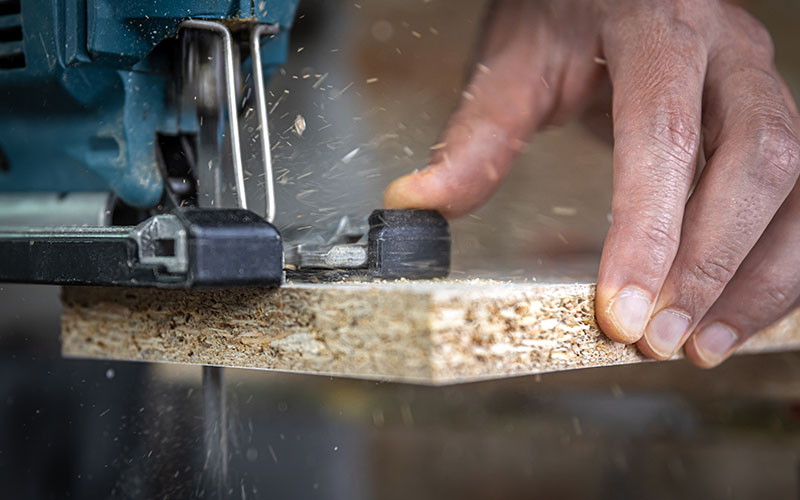
The even density allows fast machine cutting. CNC routers cut and drill the boards without splitting. The clean edges accept machine PVC or ABS edge-banding without gaps.
Screw Holding Capacity
Screw holding strength decides the board’s use for furniture building. The board faces provide strong grip for threaded screws.
Face screw holding strength averages 1000 Newtons. The dense top layers grip the screw threads tightly. Special furniture screws feature deep threads to improve holding grip.
Edge screw holding strength measures lower than face strength. The lighter core layers pull apart under direct edge-screw stress. Furniture makers use cam locks and dowels instead of edge screws.
Dimensional Stability And Moisture Dynamics
Particle boards grow when exposed to air moisture. Factory tests measure this growth as the thickness swell rate.
A 24-hour water soaking test finds the exact swell rate. Standard boards swell 15% to 25% of their starting thickness. Water-resistant grades limit swelling to below 10%.
Water exposure causes permanent physical damage. The wood pieces grow and break the dried resin bonds permanently. Full edge-banding seals the board and blocks air water entry.
What Is The Difference Between Particle Board And MDF?
Medium-Density Fiberboard uses microscopic wood fibers. Particle board contains easily seen wood chips and shavings. MDF offers higher density for complex cutting and painting. Particle boards weigh less and cost much less than MDF.
Where Are The Primary Industrial Applications For These Materials?
These boards serve mostly in large commercial factories. Factories use them for flat-pack furniture frames and cabinets. Builders use them as non-load-bearing inside parts. These include wall dividers, floor bases, and soundproof door cores.
Ready-To-Assemble (RTA) Furniture And Cabinetry
The flat-pack furniture industry buys the most particle board worldwide. Factories cut melamine-faced boards into boxed consumer furniture.
Kitchen cabinet makers use the boards for inside frame building. The 16-millimeter and 18-millimeter sizes serve as the normal standard.
Office furniture makers build desks and work spaces from dense versions. The flat surface provides a solid base for laminate desk tops. Standard board sizes reduce waste during factory cutting.
Commercial Fit-Outs And Retail Fixtures
Builders make retail store displays using custom wood panels. The material costs less to buy than plywood or MDF.
Workers build display shelves, checkout counters, and kiosks from these boards. The even sizes ensure matching pieces across large store chains.
Event builders use raw boards as short-term wall dividers. The large board sizes allow fast setup of trade show booths.
Interior Construction And Sub-Flooring
Home builders use special strong grades for floor bases. Workers install heavy boards directly over wood floor beams.
Floor grade boards feature exact locking joints on all four edges. Workers glue these edges together during floor setup. The glued joints stop vertical movement between touching boards. This base layer supports carpet, laminate floors, and wood planks.
Inside contractors use thinner boards as dry walls for room dividers. The boards give a stiff, paint-ready face for light room dividers.
Specialized Millwork: Flush Door Cores
Door makers use heavy particle boards as inside door cores. The solid cores fit inside wood frames between two cover skins.
The dense core gives needed weight and hit resistance. The heavy pressed wood limits sound passing between rooms.
Solid board cores help inside doors meet safety fire ratings. A solid 44-millimeter core gives a standard 30-minute fire rating. The dense material blocks flames and smoke passing through.
Which Commercial Grades Cater To Specific Environmental Requirements?
Factory buying relies on specific performance grades to match local limits. Standard indoor boards handle completely dry spaces. Water-resistant types use special resins for damp spaces. Fire-safe boards add chemical blockers to meet commercial building safety codes.
Factories make three main grades based on chemical treatments and planned use:
- Standard Interior Grade (P2): Factories make this basic grade with UF resin strictly for dry indoor furniture.
- Moisture-Resistant Grade (P3): Factories add MUF resins and green dyes to make boards for damp bathrooms.
- Fire-Retardant Grade: Makers add fire-stopping salts and red dyes to delay fires in public buildings.
How Does Global Compliance And Integrated Supply Chain Ensure Sourcing Reliability?
Safe global buying requires strict following of global formaldehyde release limits. Working with complete company supply chains ensures steady factory quality. This plan provides stable material stock and fast global shipping for large buyers.
The table below classifies particle board panels based on exact formaldehyde release limits:
| Emission Standard | Regulatory Region | Maximum Formaldehyde Limit | Primary Application Market |
| CARB Phase 2 | California, USA | 0.09 parts per million | North American furniture imports |
| EPA TSCA Title VI | United States (Federal) | 0.09 parts per million | All composite wood sold in USA |
| E1 (EN 13986) | European Union | 0.10 parts per million | Standard European construction |
| E0 / F4-Star | Regulated Global Markets | ≤ 0.05 parts per million | Low-emission residential interiors |
FAQs
Is Particle Board Stronger Than Solid Wood?
Solid wood holds higher pulling strength and load capacity than particle board. The pressed board lacks unbroken wood grain lines. Solid wood supports heavy building loads. Particle board works strictly as a non-load-bearing panel part.
Can You Paint Or Stain Particle Board?
You can paint raw boards using oil-based or acrylic paints. You cannot properly stain the material. Stains need natural wood grain to soak in. The mixed wood pieces absorb liquid stain unevenly.
Is Particle Board Waterproof?
Standard boards absorb water fast and take permanent physical damage. Water-resistant grades handle short periods of high air moisture. No particle board handles direct water soaking. Full covering with plastic sheets or edge-banding provides working water cover.
How Long Does Particle Board Furniture Last?
Well-made and sealed particle board furniture lasts 10 to 15 years. This life span needs completely dry indoor spaces. Water exposure cuts this life span heavily. Extreme heat shifts or repeated taking apart also break down the wood.
How Heavy Is A Standard Sheet Of Particle Board?
A standard 18-millimeter thick board measuring 1220 by 2440 millimeters weighs 36 kilograms. Water-resistant and fire-safe versions weigh slightly more.
Learn More About Our Products?
Contact Now