
Plywood Structure: Layer Orientation, Core Composition, and Engineering Properties Explained
Wood’s a bit unpredictable. It holds up well along the grain but weakens across it, and it swells or shrinks with every humidity swing.
Plywood tackles this by crossing wood layers and engineering the core, turning inconsistent wood into a much more stable, reliable panel.
Plywood panels get their balance from layer orientation, symmetry, and always using an odd number of plies. Each veneer crosses the next, so the grain directions oppose each other, which cuts down on movement and spreads out loads.
That’s how plywood manufacturing transforms raw wood into an engineered material that warps less, keeps its shape, and just performs better over time.
Core composition and adhesive choices also shape how plywood handles stress. Denser cores grip fasteners better, while the right glue keeps strength up for the long haul.
These design tweaks make plywood the go-to for furniture, cabinets, doors, and construction—anywhere you need something you can trust to last.
The Principle of Cross-Lamination
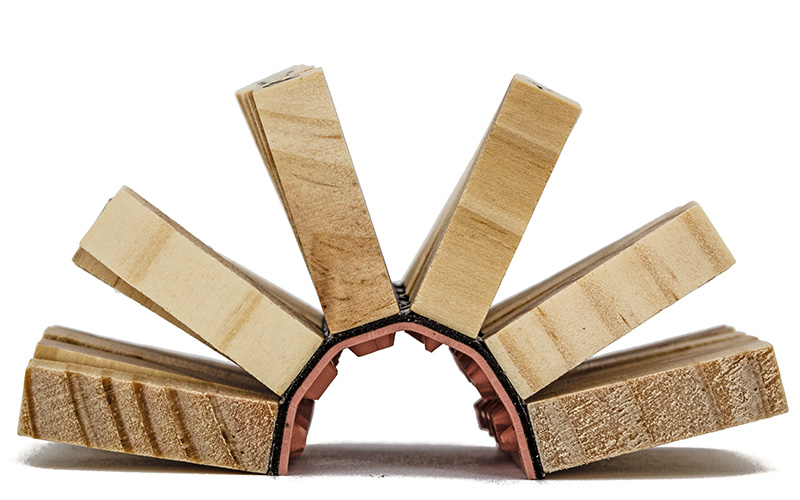
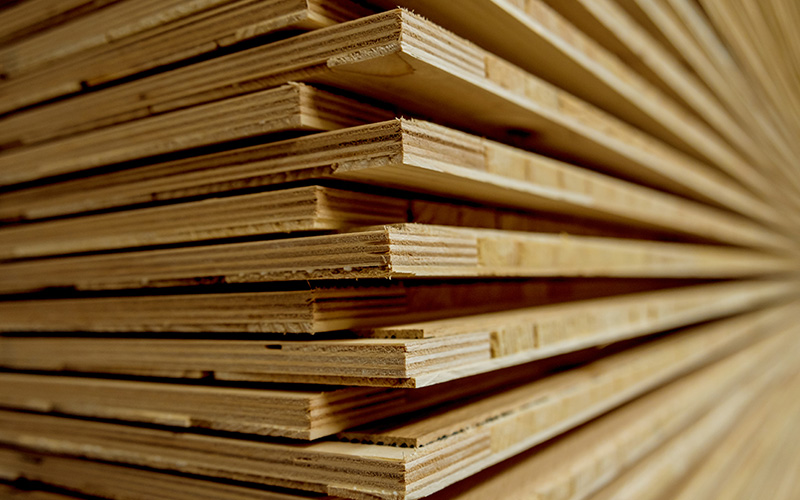
Cross-lamination is at the heart of how plywood’s built. Each ply or wood veneer layer gets rotated 90° from the one before, so the grain runs perpendicular between layers.
This isn’t just for show—it’s the rule for all structural plywood, whether the panel’s thin or thick.
The face veneer and back veneer usually line up with the same grain direction, while the core plies in between flip the grain back and forth. This setup evens out the forces and keeps moisture from making the panel go wonky.
The real magic is in restraint. Wood wants to expand and shrink across the grain, but the cross-laminated layers above and below hold it in check.
Each layer pulls against its neighbors, so internal stresses cancel each other out. That’s why plywood panels stay flatter and resist warping, cupping, or twisting.
Veneer thickness changes things up. Thin veneers, usually 1–3 mm, spread out stress over more layers. Thicker veneers mean fewer glue lines but let each layer move a bit more.
Manufacturers pick veneer thickness based on panel grade and what the panel’s meant for. Thanks to cross-lamination, plywood handles loads in both directions, so it works predictably as a floor, wall, or roof, no matter which way the grain runs.
The Law of Symmetry
Plywood sticks to symmetry like glue. This rule keeps stress, shape, and load response under control. When builders follow it, panels stay flat and stable even as humidity shifts.
The Center Line Concept
Symmetry starts with an imaginary center line running through the middle ply. Every layer above this line needs a matching layer below, mirroring it in material and layout.
It’s not just about having the same number of layers—if there’s a birch veneer one up from the center, there has to be another birch veneer one down from the center, too.
This setup matters because wood moves with moisture. When both sides of the center line balance out, internal stress stays even, and panels stay flatter through seasonal changes.
Critical Variables
Symmetry means controlling a few key things in each paired layer:
| Variable | Requirement | Why It Matters |
| Épaisseur | Same veneer thickness | Keeps bending stress equal |
| Species / Density | Same wood type and density | Matches shrink and strength rates |
| Moisture Content | Same moisture level at pressing | Prevents uneven drying stress |
| Grain Direction | Same fiber direction | Balances movement and stiffness |
Manufacturers stay on top of these variables during layup and pressing. Since veneers shrink more across the grain, matching grain direction is crucial for keeping things even.
That’s why panels stay stable after installation instead of slowly twisting out of shape.
Failure Scenario
Break the symmetry rule, and things go south fast. One common mistake is putting different wood species on opposite sides of the center line—say, birch on one face and poplar on the other.
Birch is denser and shrinks less than poplar. When humidity changes, one side moves more, building up stress on just one side.
This leads to warping or twisting, sometimes in just a few months. Suddenly, cabinet doors won’t close square, or floor panels lift at the edges. Symmetry keeps those moisture-driven forces in check and panels behaving as they should.
Why An Odd Number of Layers?
Plywood almost always uses an odd number of plies—think 3, 5, or 7. This isn’t random; it follows the rules of symmetry and cross-grain layering, which shape how the panel handles load, moisture, and temperature.
An odd count means there’s a single center core veneer. Each layer above the center mirrors one below, keeping forces balanced so the panel bends evenly instead of twisting.
Bending stress is highest at the central plane. With an odd number of plies, that plane runs through solid wood, not a glue line.
This helps the panel resist cracking and keeps layers from peeling apart during use.
Even-numbered plies put the center plane right on a glue line. Glue just doesn’t have the same shear strength as wood fibers, so there’s a bigger risk of delamination, especially in floors, shelves, and wall panels.
Odd layering also locks in the cross-grain pattern, letting the center layer restrain movement from humidity shifts.
Core Construction Types
Core construction shapes everything—composition, weight, and how plywood handles loads. Hardwood, softwood, and mixed cores each have their niche in interior, exterior, and industrial plywood.
Full Hardwood
Full hardwood cores use dense woods like birch plywood or eucalyptus. Densities often go over 700 kg/m³, which bumps up stiffness since those fibers really push back on compression and shear.
Manufacturers stack up lots of thin, cross-oriented plies, so the alternating grain keeps humidity from causing much swelling. This keeps panels flat in controlled interiors.
These cores show up in industrial plywood, flooring substrates, and structural panels. They’re also good for exterior plywood when paired with phenolic glue.
So, if you want better load control in cabinets or machinery bases—and don’t mind a little extra weight—this is the way to go.
Softwood Core
Softwood cores stick with pine or spruce. Densities usually land between 400–500 kg/m³, so panels are lighter thanks to more air in the cell structure.
Lighter panels mean less dead load on roofs and walls. Producers often use wider plies to save on material and press faster, which trades off some stiffness for weight savings.
Softwood cores are everywhere in construction-grade plywood—wall sheathing, roof decks, subfloors. In exterior plywood, waterproof adhesives protect the core, but the wood itself can dent during rough handling.
Combi Core
Combi core is a layered “sandwich.” Hardwood veneers go on the face and back, with softwood or poplar inside. The hardwood faces resist dents and add surface hardness.
The softer core cuts down on weight and cost. This balance keeps panels flat but still easy to move around. Furniture panels often use this setup for stable, finish-ready surfaces.
Combi cores pop up in interior plywood, cabinetry, and shop panels. Some exterior grades use this design with weather-rated glue.
It’s a nice compromise: smooth faces without the heft of a full hardwood core.
The Impact of Density on Fastener Holding
Plywood density really controls how well screws and nails grip. The core layers do most of the work—fasteners dig into the wood fibers, not the glue lines.
Lower density means fibers crush more easily, so fasteners can loosen when under stress.
Research shows a clear link between local density and withdrawal strength. Higher core density helps screws resist pull-out and head pull-through at bigger loads.
So, two panels with the same thickness can behave very differently if their core densities aren’t the same.
Why density matters for fasteners:
- Higher density cores mean tighter fiber packing, more friction, and better grip around threads.
- Lower density cores (like some poplar or mixed-lightwood) give way sooner under load.
- Surface densification helps near the face but can’t make up for a soft core underneath.
For subfloors, fastener holding keeps squeaks down and the floor stiff. Denser plywood keeps nails and screws from working loose as people walk or as seasons change.
On roofs, better holding means fasteners are less likely to back out in high winds.
So, just having thick plywood isn’t enough. It’s what’s inside—the density—that really determines whether fasteners will stay tight for years.
Bonding Durability Grades
Bonding durability grades show how the glue layer holds up to moisture, heat, and time. These grades focus on adhesive chemistry, not how the veneers look.
In reality, the bond grade usually decides where you can use a certain plywood type.
Interior (MR) bonds use urea-based adhesives. These adhesives mostly grip the wood physically, not through a chemical reaction.
Moisture weakens this bond, so the layers can split apart in damp conditions. That’s why MR plywood works best in dry spots like cabinets or interior walls.
Exterior and structural bonds use phenolic or WBP adhesives. These cure by chemical cross-linking, creating a rigid, water-insoluble glue line.
Since the glue doesn’t soften when wet, the bond stays stable even in rain or humidity. That lets you use it for roof sheathing, subfloors, and outdoor jobs.
Here’s a quick look at common bond grades and what they mean:
| Bond Grade | Adhesive Type | Moisture Exposure | Typical Use |
| MR (Interior) | Urea formaldehyde | Dry only | Furniture, interiors |
| Exposure 1 | Phenolic blend | Temporary moisture | Construction stages |
| Exterior / WBP | Phenolic resin | Continuous wetting | Structural panels |
Structural plywood relies on two things. The cross-laminated veneer layout spreads loads, while the phenolic glue locks everything into a stiff panel.
Plywood only gets a structural rating if both the wood layout and glue bond meet the standard.
Understanding MOE and MOR
MOE and MOR describe the main properties of plywood that engineers watch to predict how panels behave under load. They measure stiffness and failure limits, not looks or finish.
MOE (Modulus of Elasticity) is all about stiffness. It tells you how much a panel bends when you put weight on it.
A higher MOE means the panel sags less because the layers resist bending. In practice, that means shelves and panels stay straighter over time.
Plywood has different MOE values parallel and perpendicular to the face grain. Cross-laminated layers reduce the difference between these directions because the alternating grain spreads stress.
This gives more uniform behavior than solid wood, though the numbers never totally match.
MOR (Modulus of Rupture) measures the max bending load a panel can take before breaking. It sets the load limit, not the day-to-day sag.
MOR helps you figure out how much weight a panel can hold before it cracks or snaps.
Core composition matters for both. Veneer cores spread stress through thin layers, while lumber or engineered cores change how loads move in the panel.
This explains why plywood often has a good strength-to-weight ratio compared to solid wood.
Rolling Shear Strength
Rolling shear strength shows how well plywood resists shear forces in the cross layers, where the grain runs across the panel. These layers fail when wood fibers rotate and slide past each other under stress.
This is why cross-band quality matters as much as the face veneers in structural panels.
Cross-layer orientation drives this behavior because shear stress acts across the grain. Wood handles load well along the grain but not so much across it.
In real use, floors, roofs, and beams often fail in the core before the faces show any damage.
Test data from structural plywood and OSB usually puts rolling shear strength between 1.3 and 2.4 MPa, depending on panel type and core.
Since values stay close in both directions, designers treat rolling shear as a core property. Thicker or higher-grade cores cut the risk of hidden failure.
Core composition really matters here. Panels with uniform, defect-free veneers show more predictable shear strength because the load spreads out better.
Gaps, weak glue, or low-density cores concentrate stress and trigger early cracking.
Things that influence rolling shear strength:
- Cross-layer density and veneer quality
- Adhesive type and bond integrity
- Span-to-depth ratio during loading
In engineered systems like CLT and plywood beams, rolling shear often sets the design limit. So, panel selection should match the shear demand, not just the bending strength.
Frequently Asked Questions
What factors determine the structural properties of plywood?
Layer orientation sets the tone for strength. Manufacturers rotate each veneer so the grain runs at right angles to the next, which spreads loads and limits bending in one direction.
Core composition matters too. Veneer cores spread stress through many thin layers, while lumber cores use solid strips that grab screws better.
This choice affects how the panel handles weight and fasteners. Adhesive type and press quality also play a part. Heat-cured glues block moisture, helping the panel keep its shape.
How do the engineering properties of plywood vary with thickness?
Thicker panels resist bending more. The outer veneers sit farther from the center, which raises the moment of inertia.
Load capacity goes up with thickness—but so does weight. That’s why floors and roofs usually get thicker panels, while cabinets stick to thinner ones to save weight.
Fastener performance improves as thickness grows. Thicker panels give screws more bite, which helps keep things together under load.
What are some common uses of plywood in building and construction?
Builders reach for plywood in subfloors, wall sheathing, and roof decks. The cross-laminated layers spread loads, helping panels handle foot traffic and wind.
Inside, plywood works for cabinets, casework, and partitions. Flat cores like MDF-core panels take paint or laminate well, keeping doors and panels aligned.
Specialty uses include concrete forms and marine panels. These pair the right cores with moisture-resistant glues, so they stand up to repeated wetting.
What distinguishes the core layer of plywood from the other layers?
The core sits right between the face and back veneers. It’s the part that gives plywood its structure and carries most of the load.
Face veneers mostly affect appearance, not strength. The core really determines things like stiffness, how well fasteners hold, and how much the panel resists warping.
Different types of cores change how plywood behaves. Veneer cores try to balance strength and weight.
Lumber cores boost rigidity and make screw holding better. Engineered cores aim for a more uniform density, which helps keep surfaces flatter.
En savoir plus sur nos produits ?
Contact