

How Much Plywood Load Can Your Project Handle? Factors & Scenario-Based Load Calculations
Plywood load capacity is the cornerstone of structurally sound DIY, residential, and small commercial building projects—its performance directly impacts material longevity, safety, and cost-effectiveness. Unlike solid wood, plywood’s engineered criss-cross layered (cross-laminated) construction—with grains oriented at 90° angles between plies—delivers superior dimensional stability, stiffness, and load resistance for the same thickness, making it the material of choice for shelves, subfloors, roof sheathing, outdoor furniture, and structural bracing. But determining how much weight plywood can safely hold is not a guesswork task: it requires alignment with industry standards, understanding of material engineering, and consideration of project-specific variables.
This guide is grounded in the APA-The Engineered Wood Association (the global authority on engineered wood products) and ICC (International Code Council) Building Codes (adopted in all 50 U.S. states and most Canadian provinces), ensuring all load data, formulas, and recommendations are authoritative and compliant. We resolve common inconsistencies in generic plywood load data, provide professional-grade calculation methods, and offer scenario-specific guidance—no advanced engineering degree required, just clear, expert-driven advice to ensure your builds are safe, durable, and up to code.
-2-1920x1282.jpg)
Image Source:699pic.com
Table of Contents
What Is Plywood Load Capacity?
Per the APA-The Engineered Wood Association, plywood load capacity—officially referred to as safe working load (SWL)—is the maximum weight a plywood sheet can sustain without exceeding allowable deflection (bending) or experiencing structural failure. Critical to this definition is the distinction between safe working load and breaking load: SWL is intentionally set at 50-70% of the breaking load (depending on application) to account for unexpected weight, material wear, and installation variables—this safety margin is mandated by ICC Building Codes (Chapter 23, Engineered Wood Products) for all load-bearing applications.
Plywood’s load-bearing capability stems from its cross-laminated design, which distributes stress evenly across all plies, minimizing weak points and reducing deflection. Unlike solid wood, which is prone to splitting along grain lines, plywood’s alternating grain orientation resists both bending and torsion (twisting), making it ideal for dynamic load scenarios (e.g., subfloors subject to foot traffic) and static load scenarios (e.g., fixed shelving).
The APA classifies plywood load capacity into two primary categories, which form the basis of all project-specific recommendations:
- Material-dependent capacity: Determined by the plywood’s grade, ply count, wood species, adhesive type, and thickness.
- Project-dependent capacity: Determined by load type (uniform vs. point), support spacing (span), installation direction, and environmental conditions (moisture, temperature)—all governed by ICC code requirements for residential and light commercial construction.
- Industry data confirms that standard APA-rated construction plywood (e.g., CDX, ACX) can support 20-80+ lb/ft² of uniform load when installed per APA/ICC guidelines—far exceeding the typical weight demands of DIY and small building projects, provided the right material is matched to the application.
Key Factors Influencing Plywood Strength
Plywood strength is governed by five interrelated material factors, each of which is standardized by the APA to ensure consistency across manufacturers. These factors set the “base load limit” of a plywood sheet, before accounting for project-specific variables like span or load type. Understanding these factors is critical to selecting plywood that meets both safety and performance requirements.
Wood Density & Species
Wood density directly correlates to load resistance: denser species have tighter wood fibers, resulting in greater stiffness and resistance to bending (modulus of elasticity, MOE) and compression. The APA classifies plywood into three density categories based on wood species, each with defined strength ranges:
- High-density (Hardwood Plywood): Made from species like oak, maple, or birch (MOE ≥ 1.8×10⁶ psi). Heavier (35-45 lb/4’×8′ sheet for 3/4″ thickness) and extremely strong, ideal for heavy load-bearing applications (structural framing, industrial workbenches, commercial cabinetry). APA-rated high-density plywood meets ICC Type 1 standards for structural use.
- Medium-density (Softwood-Hardwood Blend): The most common type (e.g., Douglas fir, Southern yellow pine blend; MOE 1.2-1.6×10⁶ psi). Moderate weight (25-35 lb/4’×8′ sheet for 3/4″ thickness) and balanced strength, suitable for general construction, DIY projects, and residential cabinetry. APA CDX and ACX plywood fall into this category.
- Low-density (Softwood Plywood): Made from species like spruce or cedar (MOE ≤ 1.0×10⁶ psi). Lightweight (15-25 lb/4’×8′ sheet for 3/4″ thickness) and low strength, only for non-load-bearing applications (decorative panels, craft projects, trim). APA-rated low-density plywood is not approved for load-bearing use per ICC codes.
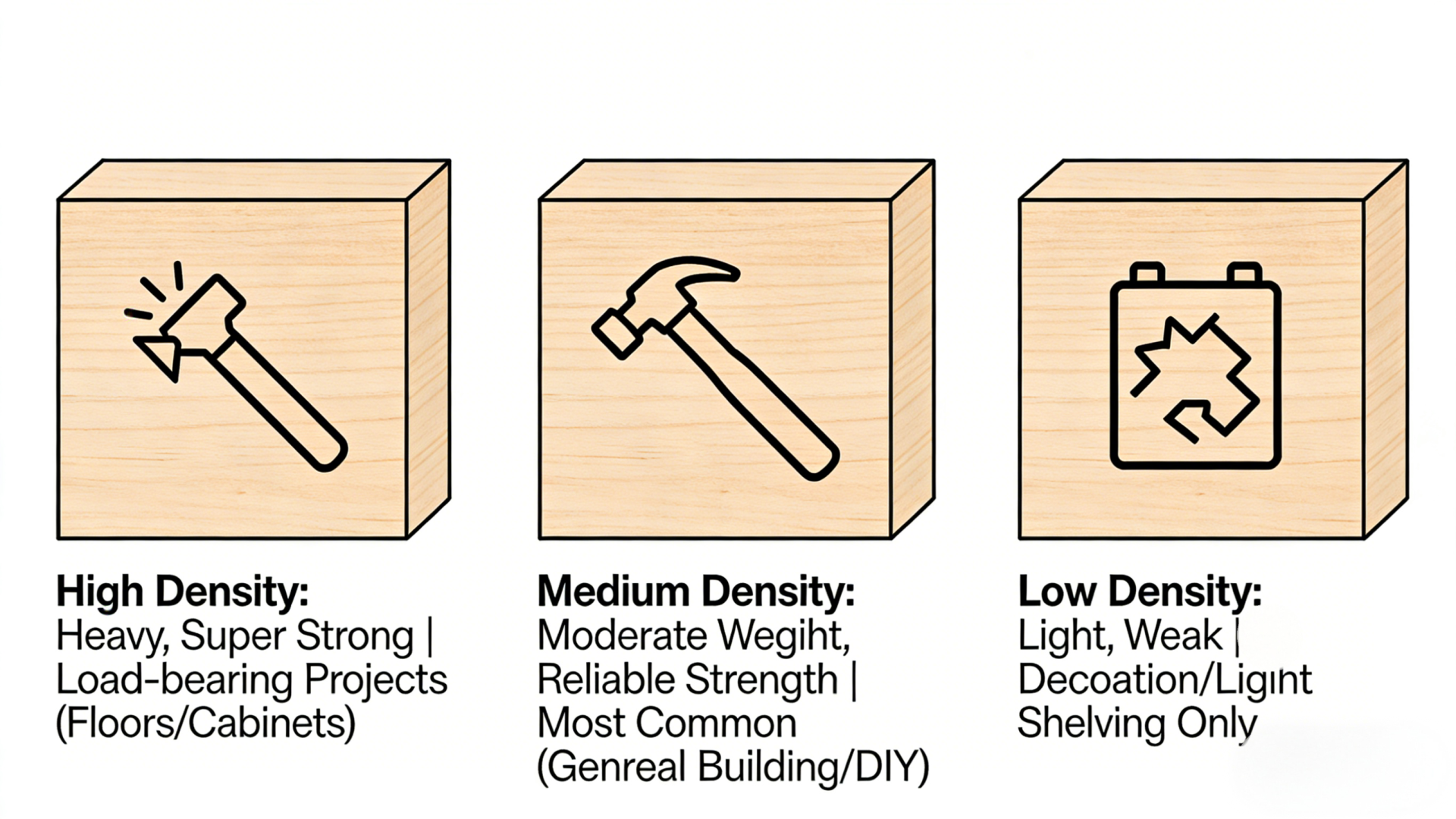
Image Source:AI Generated
Ply Count
Per APA manufacturing standards, plywood must be produced with an odd number of plies (3, 5, 7, or 9) to ensure balanced grain orientation and prevent warping. Each ply is typically 1.5-3 mm thick, and the total thickness of the sheet is the sum of all plies (plus adhesive). Ply count directly impacts stiffness and load capacity—even at the same thickness, more plies mean greater resistance to bending and delamination:
3-ply: 3 mm-6 mm thickness (1/8″-1/4″). Lightweight, low stiffness (MOE ≤ 0.8×10⁶ psi). Approved for non-load-bearing use only (decorative trim, crafts, temporary panels) per APA guidelines.
- 5-ply: 9 mm-12 mm thickness (3/8″-1/2″). Medium stiffness (MOE 1.0-1.2×10⁶ psi). Suitable for light load-bearing applications (indoor furniture, light shelving with 16″ support spacing, cabinet sides) when rated ACX or better.
- 7-ply: 15 mm-18 mm thickness (5/8″-3/4″). High stiffness (MOE 1.4-1.6×10⁶ psi). The gold standard for residential load-bearing (subfloors, roof sheathing, outdoor benches) per ICC Chapter 23.
- 9-ply: 22 mm-25 mm thickness (7/8″-1″). Ultra-high stiffness (MOE ≥ 1.8×10⁶ psi). Used for heavy structural applications (industrial workbenches, commercial subfloors, heavy outdoor supports) and meets APA Type 2 structural standards.
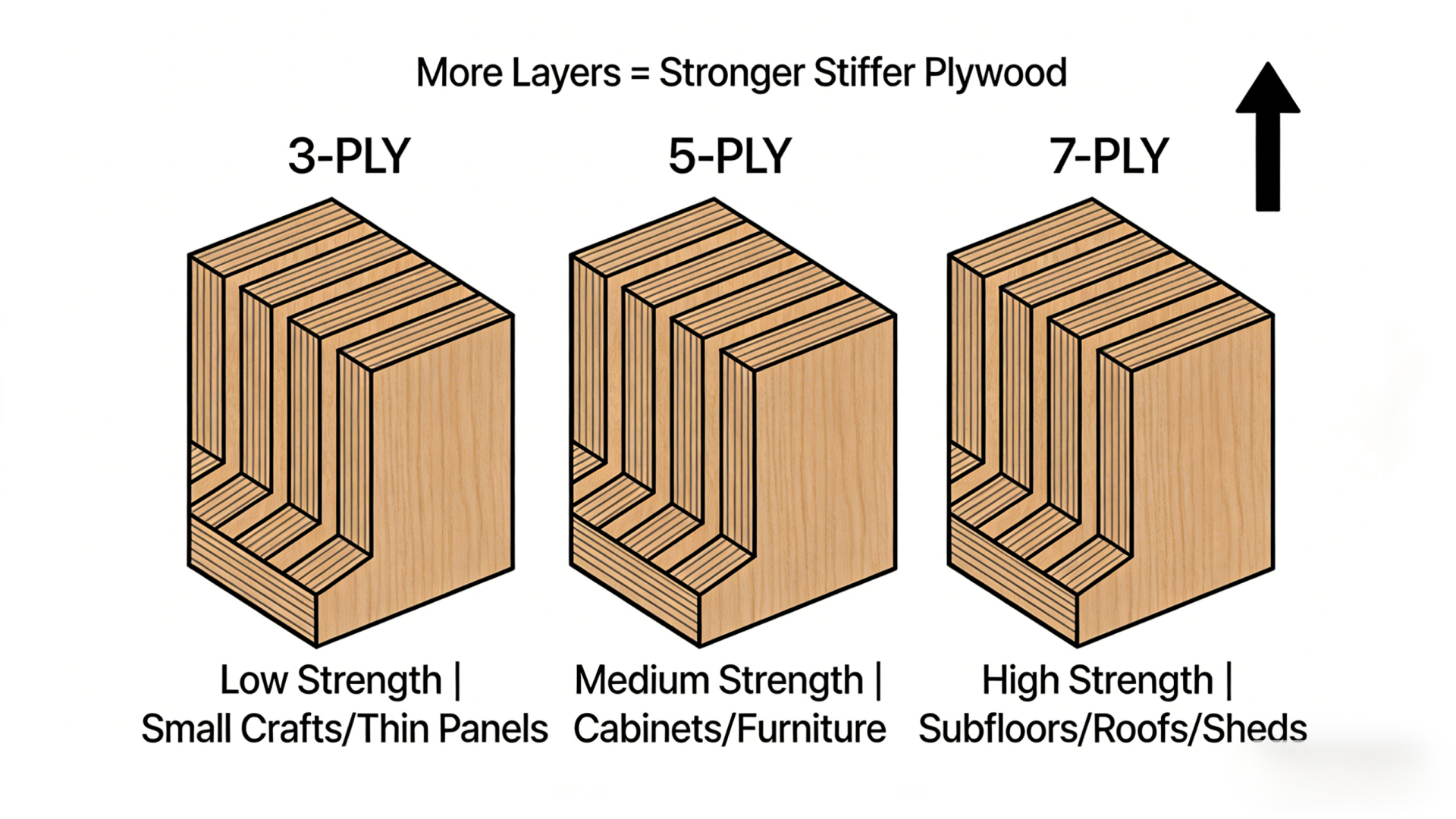
Image Source:AI Generated
Adhesive Type
Adhesive quality is a critical but often overlooked factor in plywood load capacity—weak adhesives cause delamination (layer separation) over time, which drastically reduces stiffness and load resistance. The APA rates plywood adhesives based on water resistance and load-bearing performance, with three primary classifications:
- Exterior (Waterproof) Adhesive: Used in marine-grade and exterior plywood (e.g., APA Marine Grade, Exterior CDX). Resists moisture, humidity, and temperature fluctuations, maintaining 90%+ of its strength in wet conditions. Made from phenol-formaldehyde resin, it meets ICC standards for outdoor and wet-area applications (bathrooms, decks, outdoor furniture).
- Interior-Exterior (Moisture-Resistant) Adhesive: Used in ACX and BCX plywood. Resists occasional moisture (e.g., garages, basements with proper ventilation) but not prolonged exposure to water. Maintains 70-80% of its strength in humid conditions, suitable for covered outdoor or semi-moist indoor projects.
- Interior (Standard) Adhesive: Used in interior-grade plywood (e.g., AAX, BBX). Designed for dry, climate-controlled environments (bedrooms, living rooms). Fails quickly in moisture, losing up to 50% of its strength within 48 hours of water exposure—never approved for outdoor or wet-area use per ICC codes.
Plywood Grade & Installation Direction
Plywood grade, as defined by the APA, indicates the quality of the face and back plies, as well as the structural integrity of the sheet. Higher grades have fewer defects (knots, splits, gaps) and better load-bearing performance. Common APA grades and their load-bearing applications include:
- CDX: Construction-grade plywood. Designed for structural load-bearing (subfloors, roof sheathing, wall bracing) and meets ICC Chapter 23 requirements for residential construction.
- ACX: Furniture/finish-grade plywood. Suitable for visible load-bearing applications (shelves, cabinets, outdoor furniture) where appearance and strength are both important.
- Marine Grade: Highest-quality plywood. Approved for heavy outdoor load-bearing (marine applications, outdoor decks, wet-area subfloors) and meets APA Marine Standard 480.
Installation direction is equally critical: plywood must be installed with the grain of the outer plies perpendicular to support joists or cleats. This aligns the sheet’s natural stiffness with the direction of the load, maximizing load capacity and minimizing deflection. Installing plywood parallel to supports reduces load capacity by 40-50%—a common DIY mistake that violates ICC codes and leads to premature sagging or failure.
Moisture Exposure
Moisture is the primary enemy of plywood load capacity: water swells wood fibers, weakens adhesive bonds, and causes warping—all of which reduce stiffness and load resistance. The APA classifies plywood based on moisture resistance, with clear guidelines for use:
- Kiln-Dried Plywood: Moisture content (MC) ≤ 12%. Maintains full load capacity and dimensional stability in dry, indoor environments. Ideal for all interior projects (shelves, furniture, interior walls).
- Marine-Grade/Waterproof Plywood: MC ≤ 15% when installed, with water-resistant wood and adhesive. The only APA/ICC-approved plywood for wet or outdoor load-bearing applications (decks, outdoor benches, marine structures). Maintains 90% of its load capacity in humid or wet conditions.
- Unseasoned Plywood: MC > 15%. Not approved for load-bearing use—swelling and warping will occur, leading to uneven load distribution and failure. Always use kiln-dried or marine-grade plywood for structural projects.
APA testing shows that unprotected interior plywood left in rain or high humidity can lose up to 50% of its load capacity within 72 hours—highlighting the importance of moisture control in load-bearing applications.
Standardized Plywood Thickness, Weight & Base Strength Data
A common frustration for builders is conflicting plywood weight and load data across manufacturers. This section provides nominal thickness, actual thickness, weight per square foot, base strength (MOE), and typical use. All values apply to medium-density, kiln-dried, interior-exterior (ACX/CDX) plywood, the most common type for DIY and residential projects.
Thickness is the most visible indicator of load capacity: thicker sheets have more plies, greater material volume, and higher stiffness—directly translating to higher safe working loads and longer span capabilities. The “thickness-strength relationship” is a core principle of engineered wood design.
| Nominal Thickness | Actual Thickness (APA Standard) | Standardized Weight per ft² (lb) – APA Range | Base Strength (MOE × 10⁶ psi) – APA Minimum | Typical Primary Use (ICC-Approved) |
| 1/8″ (3 mm) | 3.2 mm | 1.2–1.5 | 0.6 | Crafts, veneers, decorative light panels (non-load-bearing) |
| 1/4″ (6 mm) | 6.4 mm | 2.4–2.8 | 0.8 | Light paneling, non-load-bearing cabinet trim, temporary structures |
| 1/2″ (12 mm) | 12.7 mm | 3.0–4.2 | 1.2 | Indoor furniture, light shelving (16″ support spacing), wall panels (non-structural) |
| 5/8″ (16 mm) | 15.9 mm | 4.5–5.5 | 1.4 | Mid-weight shelving, cabinetry, light subfloors (small rooms), indoor workbenches (light tools) |
| 3/4″ (18 mm) | 19.1 mm | 5.4–6.2 | 1.6 | Subfloors, heavy shelving, outdoor benches (marine-grade), structural framing (residential) |
| 1″ (25 mm)+ | 25.4 mm+ | 7–8+ | 1.8+ | Heavy structural beams, industrial workbenches, heavy outdoor supports, commercial subfloors |
Core Thickness-Strength Rule
For plywood of the same wood type, grade, and ply count, the APA defines a linear relationship between thickness and load capacity:
Thickness × 1.5 = Relative Stiffness (e.g., 3/4″ plywood is 1.5× stiffer than 1/2″ plywood of the same grade).
Stiffness directly correlates to deflection: a stiffer sheet bends 30-50% less under the same load than a thinner sheet.
A 25% increase in thickness (e.g., 1/2″ to 5/8″) delivers a 40% increase in load capacity—this is the most cost-effective way to boost load resistance without changing support spacing.
This rule is critical for DIY builders: if your project is sagging or needs to support more weight, upgrading to a thicker sheet (rather than adding more supports) is often the simplest and most compliant solution per APA guidelines.
How Span, Support Spacing & Load Type Impact Real-World Load Limits
A plywood sheet’s base load capacity (from thickness/grade) is only the starting point—real-world performance is determined by three project variables, all governed by ICC Building Codes and APA guidelines: support spacing (span), load type, and allowable deflection. These variables are the most common causes of load-related failures in DIY projects, as they are often overlooked in generic guides.
Key Definitions
To avoid confusion and ensure code compliance, it’s critical for load and span terms:
- Uniform Load (UDL): Weight distributed evenly across the entire plywood surface (e.g., subfloors, continuous countertops, fully loaded bookcases). This is the least stressful load type, as weight is spread across all plies. ICC requires UDL calculations for all residential subfloors and large-span applications.
- Point Load (Concentrated Load): Weight focused on a small area (≤12″×12″) of the plywood (e.g., a heavy tool on a shelf, a person standing on a single spot of a floor). This is the most stressful load type, as it concentrates stress on a small number of plies. The APA requires point load limits to be 50% of UDL limits to prevent localized failure.
- Support Spacing (Span): The distance between joists, cleats, or brackets supporting the plywood (measured “on center”—o.c.). The most common spans for DIY/residential projects are 16″ o.c. and 24” o.c., as specified in ICC Chapter 23. Shorter spans = higher load capacity, as stress is distributed across more supports.
- Allowable Deflection: The maximum amount of bending (measured in inches) a plywood sheet can undergo without compromising safety or performance. For most DIY projects, the APA/ICC recommends L/360 deflection (where L = span length in inches)—this means deflection is less than 1/360 of the span, resulting in “no noticeable sag” (e.g., a 48″ span can deflect up to 0.13″ before sag is visible).
Core Span & Load Rules
These rules are non-negotiable for code-compliant, safe builds—violating them can lead to structural failure and void any manufacturer warranties:
For the same plywood thickness/grade: Longer span = lower safe load (e.g., 3/4″ plywood on 24″ o.c. supports has 33% less load capacity than the same sheet on 16″ o.c.).
Point load limits must be 50% of UDL limits (APA PRP-108 requirement) to prevent localized bending and failure.
24″ o.c. support spacing requires a 30-40% reduction in load capacity compared to 16″ o.c. (ICC Chapter 23).
A full 4’×8′ plywood sheet supported only at the ends (span = 96″) will deflect 0.5″+ under 10 lb/ft² of UDL—never use two supports for large sheets in load-bearing applications.
For spans exceeding 24″ o.c., upgrade to a thicker plywood sheet or add intermediate supports (ICC code requirement for load-bearing floors and roofs).
Scenario-Based Plywood Load Guidance
This section replaces generic formulas with contractor-grade, APA/ICC-aligned load limits for common DIY and residential scenarios. All values are safe working loads (SWL)—no additional safety factor is needed, as the 50-70% safety margin is already built in. Values apply to medium-density, kiln-dried ACX/CDX plywood (unless noted) with allowable deflection of L/360 (no noticeable sag).
Critical Notes Before Using
All UDL values are in pounds per square foot (lb/ft²); point load values are in pounds per 12″×12″ concentrated area (lb).
Marine-grade plywood: Reduce all load limits by 10% (waterproof glue adds durability but outdoor conditions create minor wear).
High-density hardwood plywood: Increase all load limits by 20% (greater density = higher MOE).
Plywood must be installed with outer grain perpendicular to supports—values do not apply to parallel installation .
For commercial or heavy structural projects (e.g., commercial shelving, industrial workbenches), consult the APA Plywood Design Specification (PDS) for exact load limits.
| Plywood Thickness | Support Spacing | Uniform Load (UDL) – Safe Working Load (lb/ft²) | Point Load – Safe Working Load (lb per 12″×12″ point) | Best For This Scenario |
| 1/2″ (3.0–4.2 lb/ft²) | 16″ o.c. | 25 | 12 | Indoor light shelving (even book weight), small indoor benches, wall-mounted floating shelves (short span ≤2′) |
| 1/2″ (3.0–4.2 lb/ft²) | 24″ o.c. | 15 | 7 | Non-load-bearing only – decorative shelving, light trim (no heavy weight), temporary panels |
| 5/8″ (4.5–5.5 lb/ft²) | 16″ o.c. | 40 | 20 | Mid-weight indoor shelving, kitchen cabinetry, light subfloors (small rooms ≤100 sq ft), indoor workbenches (light tools) |
| 5/8″ (4.5–5.5 lb/ft²) | 24″ o.c. | 25 | 12 | Indoor medium shelving (even weight), small outdoor benches (marine-grade), light countertops (residential) |
| 3/4″ (5.4–6.2 lb/ft²) | 16″ o.c. | 60 | 30 | Most common DIY load-bearing – subfloors (residential live loads), heavy bookshelves, outdoor benches (marine-grade), full-size workbenches, garage shelving |
| 3/4″ (5.4–6.2 lb/ft²) | 24″ o.c. | 40 | 20 | Mid-heavy subfloors (small rooms), large outdoor shelves (marine-grade), workshop tables (medium tools) |
| 1″ (7–8+ lb/ft²) | 16″ o.c. | 80 | 40 | Ultra-heavy load-bearing – industrial workbenches, heavy structural framing, garage floor subfloors, large outdoor storage sheds |
| 1″ (7–8+ lb/ft²) | 24″ o.c. | 60 | 30 | Heavy outdoor structural projects (marine-grade), commercial shelving (light-duty), heavy equipment stands |
Quick Project Match Examples
Heavy Bookshelf (Uniform Load): 3/4″ ACX plywood, 16″ o.c. supports → 60 lb/ft² UDL. A 2’×4′ shelf (8 sq ft) can safely hold 480 lb (60 lb/ft² × 8 sq ft)—enough for full stacks of hardcover books (≈50 lb per linear foot of shelf).
Garage Workbench (Point Load): 3/4″ CDX plywood, 16″ o.c. supports → 30 lb per point. Safe for a 25 lb drill press or 30 lb vice—compliant with APA guidelines for light industrial workbenches.
Residential Subfloor (Uniform Load): 3/4″ CDX plywood, 16″ o.c. joists → 60 lb/ft² UDL. Exceeds ICC’s standard residential live load requirement of 40 lb/ft², providing an extra safety margin for furniture, foot traffic, and unexpected weight.
Outdoor Bench (Marine-Grade, Point Load): 3/4″ marine-grade plywood, 16″ o.c. supports → 27 lb per point (30 lb – 10% for marine-grade). Safe for adult weight (150-200 lb) when distributed across 6+ points (bench seat width ≥60″).
Professional Tips to Ensure Plywood Load Safety
Even with the right plywood, improper installation or maintenance can compromise load capacity. These tips are derived from APA guidelines and contractor best practices, addressing the most common DIY mistakes that lead to load-related failures.
Match Plywood Thickness & Grade to Your Exact Scenario
Use the Scenario-Based Load Guidance Table as your primary reference—never use thin plywood (1/8″, 1/4″) for load-bearing applications. For outdoor/wet projects, always upgrade to marine-grade plywood and follow the 10% load reduction rule. For heavy structural jobs (subfloors, roofs), use 7-ply CDX plywood—this is the minimum requirement.
Pro Tip: Always check the plywood’s APA stamp before purchase—it will indicate grade, adhesive type, and load-bearing approval (e.g., “CDX Exterior” for structural use).
Space Supports Correctly
Sagging is the most common load-related issue, and 90% of cases are caused by overly wide support spacing (not incorrect plywood thickness). Follow these APA/ICC-approved support rules:
Use 16″ o.c. spacing for all heavy load-bearing jobs (subfloors, heavy shelving, workbenches).
Use 24″ o.c. spacing only for mid-light loads (medium shelving, small outdoor benches).
Never support a full 4’×8′ sheet with only two brackets/joists—add intermediate supports to achieve 16″/24″ o.c. spacing.
For floating shelves or short spans (≤2′), use 12″ o.c. spacing for maximum stiffness (no sag).
Install Plywood in the Correct Direction
Plywood must be installed with the outer layer grain perpendicular to supports. This aligns the sheet’s engineered stiffness with the load direction, maximizing load capacity and minimizing deflection. Installing plywood parallel to supports cuts load capacity by 40-50%—a mistake that is easy to avoid but often overlooked in DIY projects.
Pro Tip: Check the plywood’s grain direction—outer plies will have visible grain lines; align these lines perpendicular to joists/cleats.
Avoid Moisture & Damaged Plywood
Store and install indoor plywood in dry, climate-controlled areas—never use plywood in wet basements/attics without proper ventilation.
Inspect plywood for defects before use: reject sheets with cracks, splits, delamination (loose layers), or soft spots—these are weak points that will fail instantly under load, even if the rest of the sheet is strong.
For outdoor plywood, seal all edges and surfaces with a water-resistant sealer (e.g., polyurethane, marine varnish) to prevent moisture absorption—this extends load capacity and longevity by 50%+.
결론
Selecting the right plywood for your project’s load needs is not guesswork—it’s a matter of aligning, understanding material engineering, and matching plywood specs to your project’s unique variables. The core takeaways from this guide—grounded in industry authority—are simple to apply:
Plywood load capacity is determined by two key factors: material properties (thickness, grade, ply count, adhesive) and project variables (span, load type, moisture).
- Thicker plywood = greater stiffness = higher load capacity—this is the most cost-effective way to boost performance.
- Support spacing is critical: 16″ o.c. is the standard for heavy load-bearing, 24″ o.c. for light loads—never use two supports for large sheets.
Follow APA/ICC guidelines for installation direction (outer grain perpendicular to supports) and moisture control to maintain load capacity over time.
By following these expert recommendations, you can use plywood with confidence for any DIY, residential, or small commercial project. Your build will be structurally sound, code-compliant, and durable—avoiding the costly mistakes that come from generic, AI-generated advice. For complex projects, always consult the APA Plywood Design Specification (PDS) or a licensed structural engineer to ensure full compliance.
FAQ
Q1: What’s the safe load for 3/4″ plywood—the most common DIY choice?
A: For 3/4″ medium-density ACX/CDX plywood (16″ o.c. supports, the most common residential setup), the safe working load is 60 lb/ft² (uniform load) or 30 lb per point (point load). This includes the required 50-70% safety margin and delivers L/360 deflection (no noticeable sag)—perfect for subfloors, heavy shelving, workbenches, and outdoor benches (marine-grade). For 24″ o.c. supports, the load limit drops to 40 lb/ft² (uniform) / 20 lb per point (point).
Q2: Why does my plywood sag even if I used the right thickness?
A: Sagging is almost always caused by one of three violations: (1) Support spacing is too wide (e.g., 24″ o.c. for a heavy load that requires 16″ o.c.), (2) Plywood is installed with the grain parallel to supports (cuts stiffness by 40-50%), or (3) You’re applying a point load without reducing the UDL limit by 50% (per APA guidelines). Fix support spacing first—this is the easiest and most effective solution to eliminate sagging.
Q3: Can I use regular plywood for outdoor projects with heavy loads?
A: No. Regular interior plywood (e.g., AAX, BMX) loses up to 50% of its strength when exposed to moisture/rain, and delamination will occur within weeks of outdoor exposure—leading to structural failure. For outdoor load-bearing projects, use marine-grade plywood, which has waterproof adhesive and water-resistant wood. Always reduce marine-grade load limits by 10% and seal all edges/surfaces for extra moisture protection.
Q4: Are thin plywood sheets (1/8″, 1/4″) good for any load-bearing jobs?
A: No. 1/8″ and 1/4″ plywood are for non-load-bearing use only (crafts, veneers, light trim). Even with close support spacing, these thin sheets have low MOE (≤0.8×10⁶ psi) and cannot safely hold weight—using them for shelves, floors, or benches will result in immediate sagging or failure, and violates ICC building codes for load-bearing applications.
Q5: How do I calculate the total safe weight for my plywood project?
A: For uniform load (even weight distribution): Multiply the safe load per square foot (from the scenario table) by the total square footage of the plywood sheet. Example: 3/4″ plywood, 16″ o.c. supports → 60 lb/ft² × 8 sq ft (2’×4′ shelf) = 480 lb total safe weight. For point load (concentrated weight): Use the per-point limit directly (e.g., 30 lb per point = one 30 lb object per 12″×12″ area—no need to calculate square footage).
제품에 대해 자세히 알아보시겠습니까?
지금 문의