
Mobile Home Floors: What Size Plywood Do You Need?
Standing in a hardware store, staring at plywood sheets labeled 1/2 inch, 3/4 inch, 1 inch—if you’re renovating a mobile home, this confusion is familiar. Will 1/2 inch hold your furniture? Is 3/4 inch overkill? Here’s the short answer: 3/4 inch (19mm) is the universal choice for most main living areas; 1/2 inch (12mm) is only suitable for low-traffic secondary spaces like narrow hallways and storage rooms; 1 inch (25mm) is reserved for high-weight-bearing indoor zones and outdoor areas such as decks. Mobile home floors require plywood that strikes a balance between lightness and structural strength—this guide breaks down the key considerations to help you choose confidently, avoid costly mistakes, and build a durable subfloor.
2 Key Plywood Categories for Mobile Home Floors
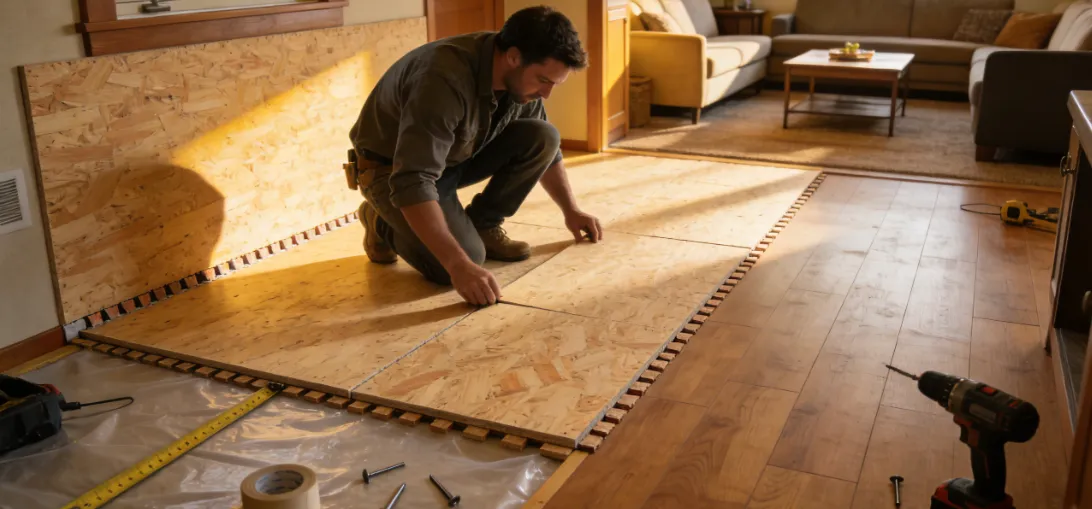
Pairing the wrong plywood category with an improper thickness is a leading cause of premature floor failure. Below is a detailed breakdown of each type, including pros, cons, and recommended size ranges for mobile home applications:
Solid Plywood (Preferred for Main Living Areas)
- Construction: Cross-grain laminated real wood veneer layers, with each layer’s grain perpendicular to the next, ensuring optimal strength, dimensional stability, and warp resistance.
- Ideal use cases: High-traffic, weight-critical zones including living rooms, bedrooms, and kitchens—where consistent load-bearing capacity is non-negotiable.
- Recommended grades for mobile homes:
- ACX: Smooth “A” face (ideal for spaces without additional finished flooring) and rough “C” face;
- CDX: Rough “C”/”D” dual faces, a cost-effective option for subfloors covered by carpet, vinyl, or hardwood.
- Sweet spot thickness: 3/4 inch—sturdy enough for daily residential use, yet lightweight enough to avoid overloading the mobile home’s structural frame.
Composite Plywood (Cost-Effective, Moisture-Resistant Alternative)
- Construction: Compressed wood fibers/sawdust bonded with a resin binder, forming a uniform sheet material.
- 2.Core advantages: Lower cost than solid plywood; superior surface moisture resistance compared to other panels (making it a better choice for humid zones like bathrooms and laundry rooms, where incidental splashes are common).
- Key limitations: 10-15% lower structural strength than solid plywood of the same thickness; prone to water damage and delamination if exposed to standing water or unsealed moisture.
- Critical note: Mandatory proper sealing is required for all applications—even in low-moisture areas—to prevent water penetration.
- Sizing tip: Size up for high-traffic zones (e.g., 3/4 inch composite for budget-friendly kitchen subfloors, never 1/2 inch).
| Plywood Category | Key Advantages | Key Disadvantages | Recommended Size Range |
| Solid Plywood | High structural strength, long-term durability, excellent warp resistance | Higher cost vs. composite | 1/2 inch (secondary areas) – 1 inch (special high-load/outdoor areas) |
| Composite Plywood | Cost-effective, superior surface moisture resistance | 10-15% lower strength than solid; prone to water damage if unsealed | 3/4 inch (primary areas) – 1 inch (special high-load areas) |
Real-world mistake example: A Florida mobile home owner used 1/2 inch composite plywood for the living room to cut costs. Within 6 months, the floor sagged and developed cracks along joists under the weight of a sectional couch (≈800 lbs total). The fix: 3/4 inch solid plywood would have distributed the load evenly and prevented structural failure—highlighting composite plywood’s unsuitability for high-weight main living areas.
3 Common Plywood Thicknesses for Mobile Home Floors: Sizing by Use Case
Plywood thickness selection is determined by three core factors: space function, traffic volume, and load requirements. Below is a detailed breakdown of the three most common thicknesses, including precise load capacities, ideal applications, and critical installation considerations—with a comparison table for quick reference.
1. 1/2 Inch (12mm) Plywood: Secondary Low-Load, Low-Traffic Areas Only
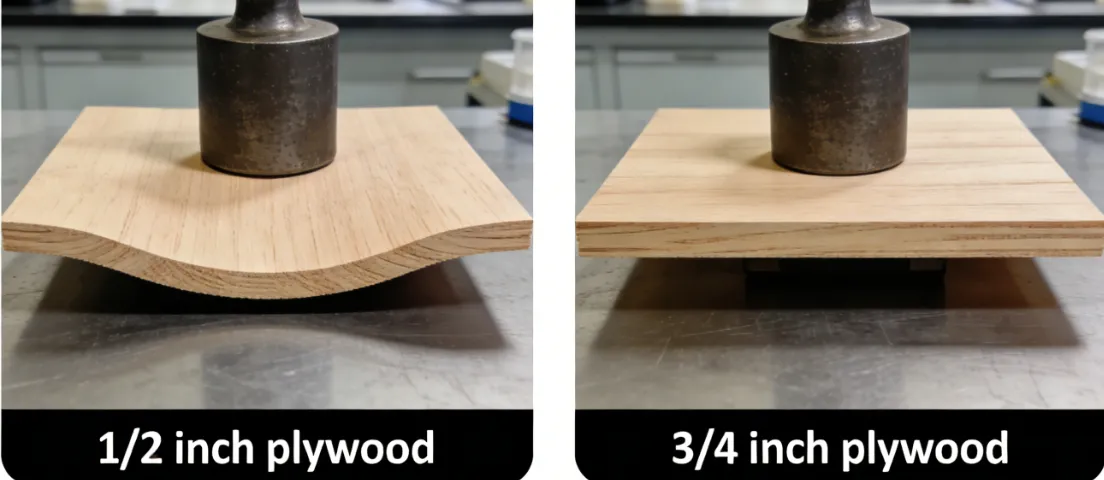
Rated load capacity: Up to 100 lbs/sq ft (uniform live load)
This thickness is only suitable for low-activity, low-weight secondary spaces—its structural rigidity is insufficient for heavy furniture, frequent foot traffic, or any moisture-prone zones. When used correctly, it is a cost-effective option for minimal-use areas.
- Ideal applications: Narrow non-main hallways, storage rooms, coat closets, small utility nooks (light foot traffic, no heavy furniture/appliances, ≤50 lbs fixed load per square foot).
- Best plywood category: Solid plywood only—composite plywood’s lower strength exacerbates sagging risks in even low-load zones.
Installation criticality: Requires joist spacing ≤12 inches on center; the common 16-inch on-center joist spacing in mobile homes is too wide for this thickness, even in storage rooms.
- Pros: Low cost, ultra-lightweight, easy to cut and install;
- Cons: Low load-bearing capacity, high sagging/cracking risk in high-traffic areas, no moisture resistance.
2. 3/4 Inch (19mm) Plywood: The Universal Choice for Main Living Areas
Rated load capacity: Up to 250 lbs/sq ft (uniform live load)
This thickness is the standard for mobile home floors. It’s versatile, balanced, and reliable. If you’re not sure how much weight your floor needs to hold, this is a safe choice.
Ideal applications: All main areas with lots of foot traffic and high weight needs, like living rooms, bedrooms, kitchens, dining rooms, and main hallways. It can support common household furniture—such as king beds (about 1,000 lbs), dining sets (about 600 lbs), and kitchen appliances (about 500 lbs).
Best plywood category: Solid plywood is preferred because it’s the strongest and most durable. If you want to save money, composite plywood works for main areas too—but avoid damp places like kitchens and bathrooms. Even with sealing, composite plywood is more likely to get damaged by splashes or spills.
Installation criticality: The distance between joists should be no more than 16 inches on center. This is the most common spacing in mobile homes.
Pros: It can hold heavy furniture and lots of foot traffic. It’s not too heavy, so it won’t overload your mobile home’s structure. It’s also cost-effective for most renovation budgets.
Cons: It’s a bit heavier (about 2.5 lbs/sq ft) and 30% more expensive than 1/2 inch plywood. But this extra cost is worth it—it helps you avoid expensive repairs later.
Real-world performance proof: A mobile home owner in Texas installed 3/4 inch solid ACX plywood in all main areas. After 10 years of use, the subfloor has no sagging or cracks. It even holds a king bed, an 8-seat dining table, and a heavy home office desk (total weight about 2,200 lbs) on the same joist span.
3. 1 Inch (25mm) Plywood: High-Load, Outdoor, and Special Structural Needs
Rated load capacity: Up to 400 lbs/sq ft (uniform live load)
This is the thickest common plywood for mobile home use, reserved for extreme structural needs—it is overkill for standard main areas and should only be used when required by load or structural conditions.
- Ideal applications: Outdoor decks/patios (exposed to weather), indoor zones with extremely heavy furniture (pianos ≈1,500 lbs, pool tables ≈800 lbs), mobile homes with wide joist spacing (≥16 inches on center), and older homes with weakened joists (for structural reinforcement).
- Best plywood category: Solid plywood only—composite plywood lacks the structural rigidity to meet the high-load demands this thickness is intended for.
- Installation criticality: Must verify mobile home weight limits (adds ≈4 lbs/sq ft vs. 3/4 inch) to avoid exceeding transport/placement compliance standards; consult a licensed contractor for joist reinforcement if needed.
- Pros: Maximum structural strength, supports extreme concentrated/uniform loads, weather-resistant for outdoor use, reinforces weakened older floor frames;
- Cons: Heaviest option (risk of structural overloading), most expensive (≈50% higher than 3/4 inch), harder to cut and install (requires heavy-duty tools).
Real-world application example: A Washington mobile home owner used 1 inch solid plywood for an attached outdoor deck (withstanding annual rain/snow and 10+ person gatherings ≈1,500 lbs total) and 3/4 inch solid plywood for the living room—balancing structural performance and cost-effectiveness.
| Plywood Thickness | Uniform Live Load Capacity | Ideal Applications | Best Plywood Category | Key Installation Considerations |
| 1/2 Inch (12mm) | Up to 100 lbs/sq ft | Narrow hallways, storage rooms, coat closets, small utility nooks | Solid Plywood | Joist spacing ≤12 inches on center; no moisture-prone zones |
| 3/4 Inch (19mm) | Up to 250 lbs/sq ft | Living rooms, bedrooms, kitchens, dining rooms, main hallways | Solid (preferred) or Composite | Joist spacing ≤16 inches on center; avoid composite in moisture-prone main zones |
| 1 Inch (25mm) | Up to 400 lbs/sq ft | Decks, patios, heavy furniture areas, wide joist spacing/weakened joist zones | Solid Plywood | Verify mobile home weight limits; consult contractor for joist reinforcement if needed |
3/4 inch plywood is the mandated minimum thickness for main living areas, as it reliably supports standard residential furniture and foot traffic without sagging or structural degradation. The association explicitly states 1/2 inch plywood is not suitable for any main living area, as it fails to meet long-term structural load requirements—aligning with real-world performance data and industry best practices.
FAQs: Answers to Your Most Common Questions
Below are the five most common questions about mobile home floor plywood, answered with industry data and MHMA 2024 standards for clarity and accuracy:
Q1: Is 3/4 inch plywood the only option for main living areas?
A1: No, but it is the most recommended and cost-effective. 1 inch plywood also works for main areas, but it is heavier (≈4 lbs/sq ft vs. 2.5 lbs/sq ft for 3/4 inch) and more expensive (≈50% higher) — it is only necessary if you have extreme concentrated loads (pianos, pool tables) or wide joist spacing (≥16 inches on center).
Q2: Can I use 1/2 inch composite plywood in my kitchen?
A2: No—this is not recommended for any reason. Kitchens are high-load (250 lbs/sq ft required) and high-moisture zones; 1/2 inch composite plywood has a 100 lbs/sq ft load capacity and will sag/crack within 6 months, even with sealing. Use 3/4 inch solid or composite plywood (sealed) for kitchen subfloors.
Q3: Do single-wide and double-wide mobile homes need different plywood sizes?
A3: The core minimum (3/4 inch for main areas) is the same, but double-wide homes may need 1 inch plywood for large open rooms or concentrated load zones due to wider joist spacing (16+ inches on center) and longer floor spans. Double-wide seam areas also require 3/4 inch+ plywood for extra support.
Q4: Do I need to replace my plywood if it’s not sagging?
A4: Not necessarily. If your current plywood is in good condition (no cracks, warping, water damage, or soft spots) and is sized appropriately for the space (e.g., 1/2 inch in a secondary area with 12-inch on-center joists), you can keep it. Only replace plywood if it is damaged or if you are upgrading the space to a higher-load use (e.g., storage room → home office).
Q5: How do I know if my joist spacing requires a thicker plywood size?
A5: Measure your joist spacing (center to center) and match to this MHMA 2024 standard (no exceptions):
- 12 inches on center: 1/2 inch (secondary), 3/4 inch (main), 1 inch (special)
- 16 inches on center: 3/4 inch (main), 1 inch (special) — 1/2 inch is too thin for any area
- 24 inches on center: 1 inch for all areas (secondary and main)
Choose Confidently, Build Durably
Choosing plywood thickness for your mobile home floor follows a simple, data-backed core rule—no guesswork required:
- 3/4 inch = main living areas (universal, MHMA-recommended minimum)
- 1/2 inch = low-traffic secondary areas (only if joist spacing is 12 inches on center)
- 1 inch = high-weight/outdoor/special structural needs (extreme loads, wide joist spacing, deck/patio)
Match thickness to plywood category, verify joist spacing first, and tailor choices to your mobile home type (single/double-wide) and budget. Plywood is the foundational structural component of your mobile home floor—cutting corners here leads to costly, irreversible damage that far outweighs any upfront savings.
Whether renovating or building new, these industry-backed tips help you avoid common mistakes and build a durable, long-lasting subfloor. If you have unique structural needs (e.g., wide joist spacing, extreme load zones), consult a licensed mobile home contractor for personalized, code-compliant recommendations.
References
- U.S. Department of Housing and Urban Development (HUD). (2023). Manufactured Home Construction and Safety Standards. Retrieved from https://www.hud.gov/program_offices/housing/mfh/mfstandards
- National Association of the Remodeling Industry (NARI). (2024). Plywood Selection Guide for Mobile Home Renovations. Retrieved from https://www.nari.org/resource-center/guides/plywood-selection/
제품에 대해 자세히 알아보시겠습니까?
지금 문의