
Plywood for Roofing: Structural Requirements, Grades & Tips
A roof depends on its decking to support weight, hold fasteners, and stay flat over time. If builders pick the wrong plywood grade or thickness, shingles wear out faster, panels sag, and leaks show up at the seams.
That’s why plywood choice is really a structural call, not just about looks. For most homes, roof sheathing uses exterior-grade, APA-rated plywood like CDX, usually in 1/2 inch or 5/8 inch thickness.
The exterior glue helps the panel resist moisture during construction. The structural rating tells you it can handle real roof loads.
In practice, this keeps the roof’s shape and fasteners locked in, even under wind or snow. Let’s break down plywood types, what the grade letters mean, and why thickness changes with span or code.
There’s also a quick comparison with OSB, and a look at how small choices at the deck level can impact the whole roof’s life.
Types of Roofing Plywood: Which Material Is Best?
The best material for roof sheathing is typically CDX plywood due to its superior moisture resistance and structural longevity, though OSB remains the most common choice for new construction because of its cost-efficiency.
- Best Overall (CDX Plywood): Uses exterior-grade glue and cross-laminated veneers to resist swelling when exposed to rain during construction, making it the industry gold standard for durability.
- Best Value (OSB): Engineered with compressed wood strands and resin to provide consistent structural strength at a lower price point, suitable for projects with strict budgets.
- Best for Efficiency (ZIP System): Integrates a water-resistive barrier directly onto the panel face, allowing crews to tape seams and skip the separate installation of roofing felt.
- Best for Compliance (FRT Plywood): Treated with fire-retardant chemicals to slow flame spread, often required by building codes for townhomes or properties near lot lines.
CDX Plywood (The Industry Standard)
CDX plywood uses exterior-rated adhesive and mixed face grades labeled C and D. The glue keeps panels from falling apart if rain hits before shingles go on.
Builders stick with CDX for roof sheathing because it holds nails tight. Cross-layered veneers spread the load out across rafters, which means shingles stay put in strong winds.
Common thicknesses are 1/2 in., 5/8 in., and 3/4 in. Thicker panels work for heavier loads, like snow zones. Codes often call for 5/8 in. on trusses spaced 24 inches apart.
OSB (Oriented Strand Board)
OSB uses compressed wood strands and water-resistant resin. The panel has a consistent strength across the sheet, so installers get predictable spacing and fastening.
OSB usually costs less than plywood, which is why it’s everywhere in new homes. When rated for roof sheathing, OSB covers the same spans as plywood.
Edges can swell if OSB stays wet too long. Water soaks in at the cut edges, so careful storage and quick dry-in matter more with OSB.
Premium & Special Options (ZIP System & FRT)
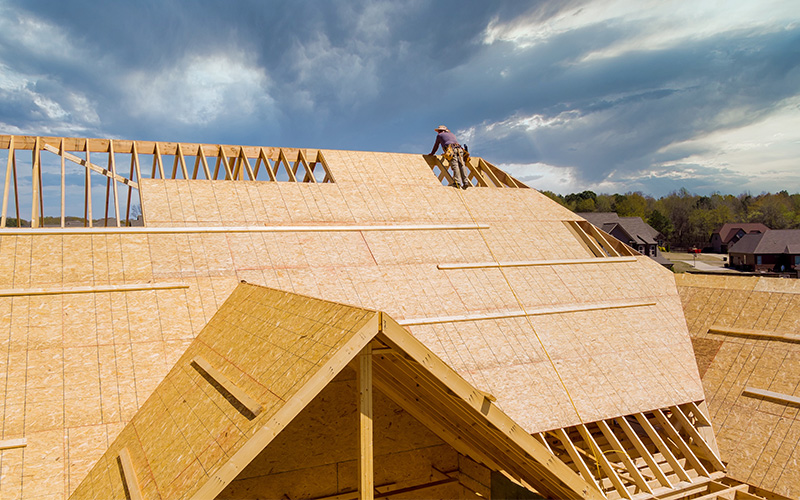
ZIP System panels combine OSB sheathing with a factory-applied water-resistive barrier. Crews seal seams with ZIP tape, skipping housewrap at the roof deck. This speeds up dry-in and cuts down leak paths.
Fire-retardant-treated (FRT) plywood uses pressure-applied chemicals to meet fire spread limits. Many products meet ASTM E84 burning tests, making them an option where codes restrict untreated wood, like near property lines.
Pressure-treated plywood targets moisture and bugs, not fire. It’s usually used at roof edges or damp zones where rot risk is high.
Comparison Chart: Plywood vs. OSB
| Feature | CDX Plywood | OSB |
| Material build | Cross‑laminated veneers | Oriented wood strands |
| Adhesive | Exterior‑rated glue | Water‑resistant resin |
| Nail holding | Strong due to veneers | Consistent but edge‑sensitive |
| Moisture behavior | Less edge swelling | Edges can swell if wet |
| Cost | Usually higher | Usually lower |
| Common uses | Roofing plywood, repairs | New roof sheathing |
Decoding Plywood Grades: What Do the Letters Mean?
Plywood grade stamps show how each sheet handles moisture, load, and exposure. For roofing, face grade and glue type work together to limit water damage and lower the risk of roof deck failure.
Understanding the A–D System
The A–D system describes the surface quality of each plywood face. Inspectors grade each side, so you’ll see combos like C/D.
The letter doesn’t measure strength—it’s about knots, repairs, and how smooth the surface looks.
| 등급 | Surface Traits | What This Means for Roofs |
| A | Smooth, no visible defects | Rarely used for roof decking |
| B | Small repairs, tight knots | Not needed for covered roofs |
| C | Tight knots, visible patches | Common face for roof decking |
| D | Open knots and voids | Used only on the hidden side |
Most roof decks use C/D plywood. One face is usable, the other’s rough, but that’s fine since shingles and underlayment cover it all.
Why “X” Matters Most for Roofs
The “X” in grades like CDX means exterior-grade glue, not a surface rating. Manufacturers use a water-resistant adhesive designed to handle repeated wetting and drying.
This adhesive usually meets Exposure 1 standards. Exposure 1 plywood can take some rain during construction, but it’s not made for permanent outdoor use.
For roof decks, this matters because panels often sit exposed before shingles go on. The glue helps prevent delamination, which is when moisture breaks the bond between plies.
Panels stay flat and intact during install, and soft spots under shingles are less likely. That’s why exterior plywood with Exposure 1 rating is the go-to for roof decks.
Roofing Plywood Thickness Requirements
Plywood thickness controls how well a roof handles weight, spans the framing, and manages moisture. Codes tie thickness to rafter spacing, span rating, and roof loads.
Material weight and install details—like expansion gaps and sealed edges—also play a role.
The Role of Rafter Spacing (16″ vs. 24″ o.c.)
Rafter spacing sets the minimum plywood thickness. At 16 inches on center, many codes allow 1/2-inch nominal plywood (15/32-inch actual) if the span rating matches the layout.
This lets the roof support shingles and foot traffic without much flex. At 24 inches on center, the span grows, so codes usually require 5/8-inch nominal plywood (19/32-inch actual) or thicker.
Builders often add H-clips between panels to stiffen edges and cut down on sagging. Roof pitch matters, too—low-slope roofs hold water longer, so thicker panels help limit bending that can stress seams.
Installers need to leave 1/8-inch expansion gaps for moisture movement.
Recommended Thickness by Roofing Material
Roofing material weight changes thickness needs. Heavier coverings mean higher dead loads.
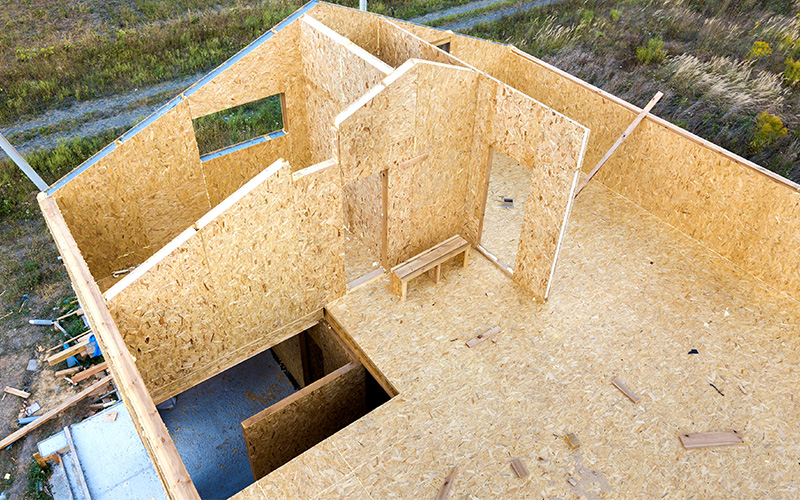
Asphalt shingles usually work with 1/2-inch plywood at 16-inch spacing or 5/8-inch plywood at 24-inch spacing. This keeps nail holding consistent and limits bounce during install.
Metal roofing weighs less, but transfers point loads through fasteners. Many builders still pick 5/8-inch plywood to reduce oil-canning and fastener wiggle.
Slate or clay tile systems need thicker decking, often 3/4-inch nominal plywood, since the material weight can get pretty high.
Moisture management matters for all materials. Sealed panel edges and exterior-rated exposure stamps help reduce swelling if panels face rain during construction.
Nominal vs. Actual Thickness Chart
Nominal sizes don’t match actual thickness because of manufacturing standards. This difference affects span rating and code compliance.
| Nominal Thickness | Actual Thickness | Common Use Case |
| 1/2 inch | 15/32 inch | 16″ o.c., asphalt shingles |
| 5/8 inch | 19/32 inch | 24″ o.c., shingles or metal |
| 3/4 inch | 23/32 inch | Tile, slate, heavy loads |
Always check the APA stamp, not just the label on the rack. The stamp gives you span rating, exposure class, and thickness—all of which matter for stiffness and moisture response.
Structural Considerations & Building Codes
Roof sheathing has to support roof load, resist wind uplift, and meet code. Panel thickness, fastening, and layout change with snow load, wind load, and local code rules.
Snow Loads and High-Wind Zones
Snow load adds vertical force to the roof deck. Codes tie this load to panel thickness and framing spacing, since thicker plywood limits bending between rafters.
For example, 5/8‑inch plywood over 24‑inch rafter spacing handles more snow than thinner panels. This cuts down on sagging and joint stress during heavy snow.
High-wind zones care about uplift, not weight. Wind tries to pull the sheathing off the framing, so codes bump up nail size, spacing, and edge fastening.
Edge nailing gets tighter because uplift forces peak at the panel’s edge. More nails along edges and corners help keep panels attached during storms.
Some codes also require blocked panel edges in wind zones. Blocking shortens unsupported edges and helps transfer loads to framing.
Local Building Codes (IRC Requirements)
Most homes in the U.S. follow the International Residential Code (IRC). The IRC sets minimums for roof sheathing materials, thickness, and fastening.
It requires exterior-rated plywood, like CDX or Exposure 1, since these resist short-term moisture. Approved thicknesses depend on rafter spacing—1/2‑inch or 5/8‑inch plywood are common, with 7/16‑inch allowed only in some cases.
Nailing schedules spell out nail type, length, and spacing. Correct fastening lets the roof load move safely into the framing.
Local amendments can change wind or snow rules, so builders need to check local code tables before starting.
결론
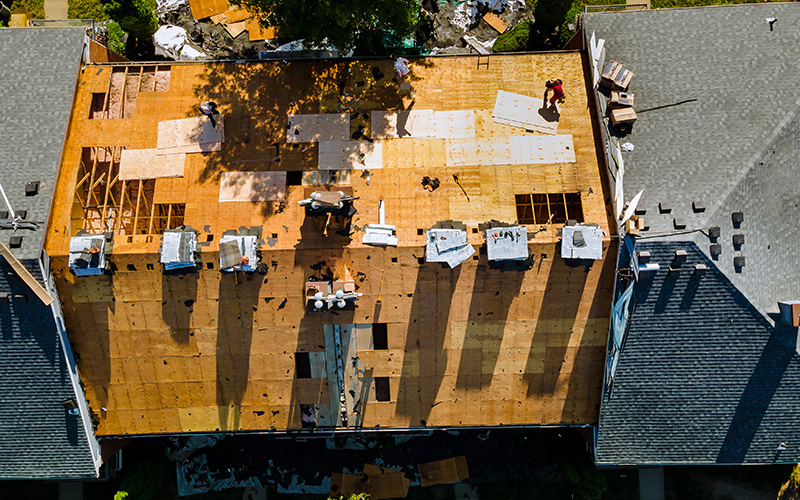
Roof sheathing acts as a structural layer by spreading loads from shingles to rafters. Builders usually pick exterior-bonded plywood like CDX because its resin stands up to short-term moisture during construction.
This type of panel keeps its shape before the roof covering goes on. Thickness should match framing spacing and expected roof loads.
For example, 1/2 inch plywood works well with 24-inch on-center rafters. Thicker panels, like 5/8 inch or 3/4 inch, fit 16-inch spacing and help limit sagging.
Grade labels show glue type and structural rating, not just surface appearance. CDX combines C and D face grades with exterior glue, which meets code for most U.S. roofs.
Even if the surface has knots, the panel still supports nails and roof loads. Installation decisions can affect long-term results.
Leaving 1/8 inch expansion gaps and following code-approved nailing patterns allows wood movement without buckling. Proper spacing and fastening help prevent waves and nail pops.
If the roof structure or spacing isn’t clear, it’s best to check with a licensed contractor in person.
Frequently Asked Questions
What is the appropriate thickness of plywood for roofing applications?
Most residential roofs use 1/2 inch plywood over rafters spaced 16 inches on center. This thickness meets common IRC span tables and supports asphalt shingles and underlayment.
Some builders pick 5/8 inch plywood for wider rafter spans or heavier roofs. The extra thickness helps panels flex less and keeps fasteners tight.
For higher loads or even wider spacing, 23/32 inch plywood shows up in code-approved designs. It’s a solid pick for snowy regions or high-wind areas.
Can you explain the grading system for plywood used in roofing?
Plywood grades describe face quality 그리고 adhesive type, not just strength. A label like CDX means a C-grade face, a D-grade back, and exterior-rated glue.
Exterior glue matters because it resists moisture-driven delamination. This keeps panels bonded during rain exposure before shingles go on.
Higher face grades, such as ACX or BCX, give smoother surfaces. That’s useful if underlayment adhesion or a visible underside calls for fewer knots or voids.
Which type of plywood is recommended for structural roofing purposes?
Exterior-grade plywood with APA or span ratings is standard for structural roof decks. These panels meet tested stiffness and load values set by the American Plywood Association.
The rating ties panel thickness to rafter spacing, so the roof deck meets code without guesswork. In most U.S. homes, CDX exterior plywood or APA-rated sheathing covers structural needs when installed with proper fastener spacing.
How does CDX plywood perform as a roofing material?
CDX plywood uses exterior adhesive that resists moisture during construction. The glue keeps the panel strong, even if it gets wet for a short time.
Its C- and D-grade faces have knots and patches, which helps keep costs down. That doesn’t really hurt its structural strength, though.
Most builders use CDX as a roof deck hidden under shingles or metal panels. It does the job pretty well in that role.
If you pick the right thickness and spacing, CDX holds nails securely. Shingles and underlayment usually stay put, even when the wind picks up—at least as far as the code expects.
제품에 대해 자세히 알아보시겠습니까?
지금 문의