One Minute to Understand MDF Board
MDF board, also known as fiberboard, is an artificial board made from wood fibers or other plant fibers, mixed with urea-formaldehyde resin or other adhesives. In addition, it boasts many excellent properties, such as a soft texture and impact resistance. Based on differences in density, it can be classified into three types: high-density, medium-density, and low-density fiberboard.
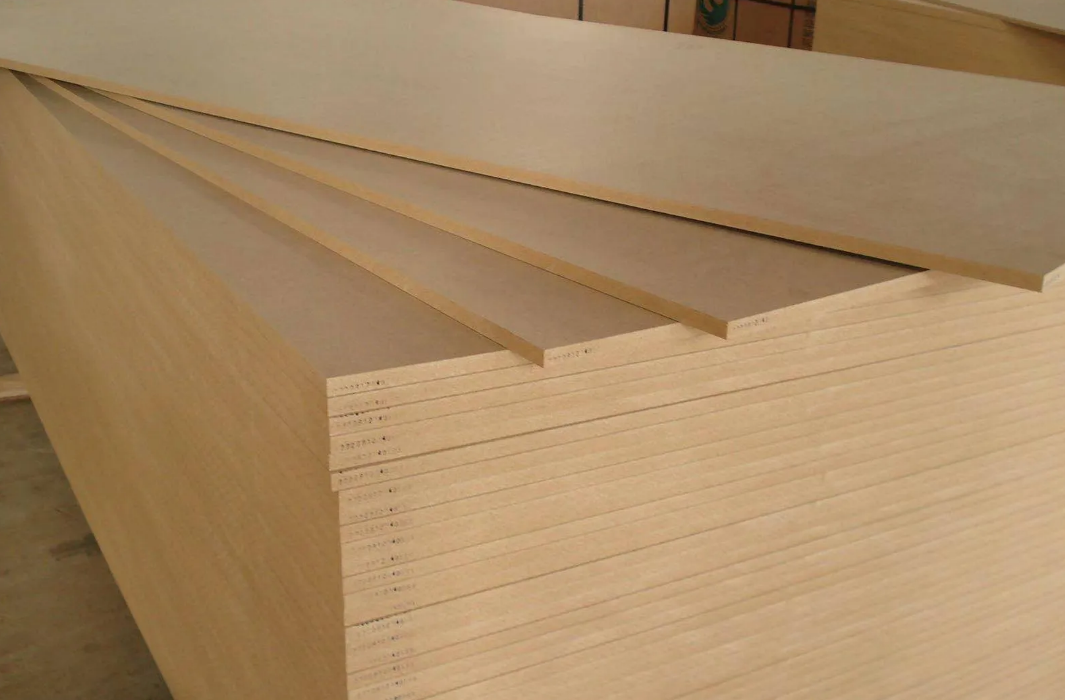
As an economical wood substitute, MDF board is widely used in various household and decoration building materials. However, as a man-made board, it is produced by mixing wood powder, wood chips with glue containing formaldehyde and benzene. To draw a daily analogy: just as the amount of water added depends on how you knead flour into dough or mix concrete, the amount of glue required varies when making density board. Consequently, density board uses more glue than most other boards, which may easily cause adverse effects on the health of occupants. For this reason, consumers generally have a poor impression of it and regard it as one of the inferior materials.
There are two common types of glue used in MDF board on the market: urea-formaldehyde resin glue and MDI glue. Urea-formaldehyde resin glue is formed by the condensation of formaldehyde and urea, with a formaldehyde emission period as long as 3 to 15 years. MDI glue, whose full Chinese name is diphenylmethane diisocyanate, is a general term for a series of upstream and downstream polymer products.To cut costs, many merchants extensively use MDF board bonded with urea-formaldehyde resin glue in invisible parts—such as bedheads, bed slats, dressers, wardrobes, and drawer bottoms. Do not purchase density board furniture merely because of its low price.
What Are the Advantages of MDF board?
MDF board in common contexts, boasts a wide range of applications. It is typically used for laminate flooring, door panels, partition walls, and furniture. Additionally, it is widely employed in interior decoration—for instance, in the surface finishing process of oil blending techniques.
One of its standout advantages is its excellent surface decorativeness. Various coatings, paints, wood veneers, printing paper, PVC, adhesive film, melamine-impregnated paper, and thin light metal sheets can all be applied to MDF smoothly. Thanks to its sound insulation and sound absorption properties, density board is frequently utilized in numerous architectural and decorative projects. Moreover, it offers good flatness, standard dimensions, sturdy edges, and is free from rot or insect holes.
MDF board is also cost-effective, with specific prices varying based on production processes and brands. To ensure quality, it is advisable to cooperate with manufacturers of well-known brands. Made from wood fibers or other plant fibers, density board is easy to shape and process. Subsequent decoration work is also relatively simple and convenient.
What Are the Disadvantages of MDF board?
The biggest disadvantage of MDF board is its poor moisture resistance—it swells upon contact with water. When using density board for skirting boards, door casing boards, or window sill boards, it is essential to paint all six sides to prevent deformation. Density board has a high water absorption expansion rate and significant deformation potential; its long-term load-bearing deformation is greater than that of homogeneous wood particleboard.
Despite its weak moisture resistance, density board offers notable advantages: it features a smooth, flat surface, fine texture, stable performance, sturdy edges, and easy formability, while avoiding issues like decay and insect infestation. In terms of bending strength and impact strength, it outperforms particleboard. Additionally, its surface has excellent decorativeness—even surpassing solid wood furniture in appearance.
Another drawback is its poor nail-holding capacity. Due to the highly fragmented nature of its fibers, density board’s nail-holding performance is far inferior to that of solid wood boards and particleboard.
MDF board boasts a wide range of applications:
Furniture Manufacturing: Thanks to its excellent processability and smooth surface, it is widely used in producing furniture such as wardrobes, bookshelves, tables, and chairs.Interior Decoration: It is commonly applied to wall and ceiling decoration, as well as the production of door panels and window frames.Audio Equipment Production: It is also suitable for manufacturing audio devices.Insulation Material: It can serve as thermal insulation and sound insulation material.